Across Wisconsin, farmers and residents are facing a breaking point. As corporate consolidation tightens its grip on agriculture, small farms are driven out of business and local economies and communities are left behind. Building a food and agriculture system that helps small farmers prosper and rural communities to thrive instead of enriching mega-corporations is an urgent priority for farmers and residents across rural Wisconsin.
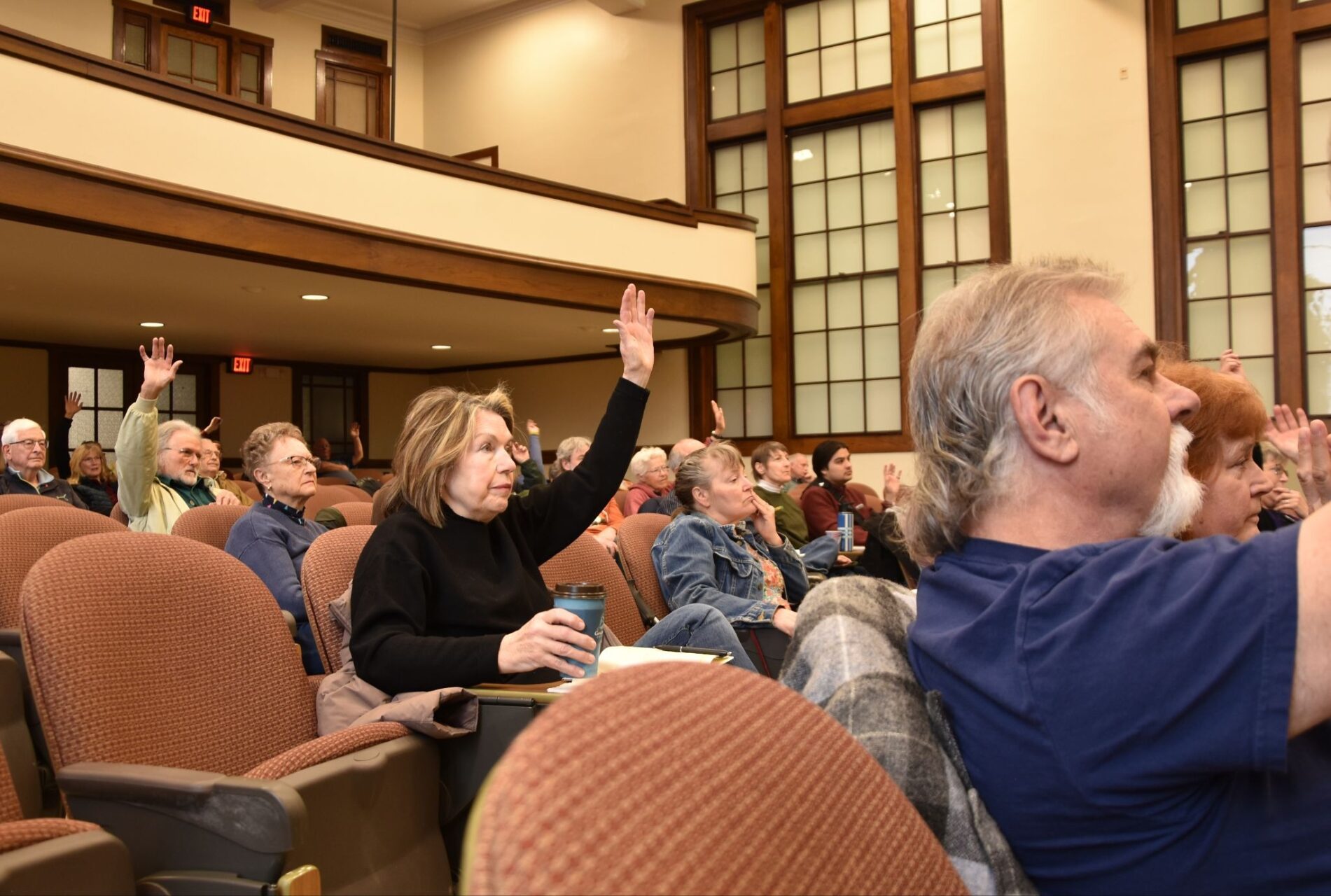
Last Saturday, 100 people gathered at the Future of Farming forum at UW-River Falls, hosted by GROWW (GrassRoots Organizing Western Wisconsin) and Pepin-Pierce Farmers Union, to confront the problem of consolidation head on and envision an alternative future.
The solution to this problem is organizing around shared interests to create a new food and agriculture system that serves communities instead of corporations. Locally focused, resilient food production is the key to building stable, healthy rural communities.
“This system has been intentionally made because regular people and regular farmers have not had enough power. The only solution to that is banding together around shared values and shared interests, to organize for a new system that benefits the many and not the few,” GROWW Organizer Danny Akenson said.
GROWW leaders are advancing a set of priorities in Madison aimed at shifting back power to local farmers and communities, including providing low-interest loans to small dairies, stronger notification requirements for manure spills, and enforceable permits requiring extra large factory farms to address economic, environmental and social impacts.
Speakers at the forum underscored the human and economic costs of the current systems.
“[Farmers and rural people] have been sacrificial lambs for a system that doesn’t even do any of what it promises. It only extracts from the land and the people,” Tom Manley, a grass-fed beef and egg farmer in the town of Gilman and Climate and Conservation Director for Marbleseed, said in his presentation to the conference.
Joining Manley as speakers were Phil Verges, a 45-year farmer in Spring Valley; Tara Greiman, the Wisconsin Farmers Union’s Director of Conservation and Stewardship; and Kristy Lynn Allen, a beekeeper and Board Chair of the St. Croix Valley Food Alliance.
Verges, a commodity farmer, spoke about how policies founded on a “get big or get out” mentality have led to corporate control of the ag supply system and overproduction that has been an economic disaster for small farmers. Between 2017 and 2022, Wisconsin lost 10 percent of its farms.
Greiman emphasized that these same policies have driven up costs and made it impossible for farmers to be self-sufficient without millions in capital assets, driving small farms out of business and creating an enormous barrier to entry for young and first-generation farmers.
“Farmers are trying to survive in a broken system,” Greiman said. “We’ve all got to come together to demand fair market rules that make the future of farming viable again, not just for corporations and shareholders, but for the people who live here.”
Speakers also challenged dominant narratives about the outcome of corporate agriculture on access to food and nutrition.
“Big Ag’s slogan that factory farms feed the world is misleading,” Manley said. Nearly one-sixth of U.S. rural and urban households experience food insecurity and less than 1 percent of U.S. food exports are sent to countries that need the most food support.
For many at the forum, the path forward is clear: rebuild local food systems that keep wealth in our communities, strengthen connections between farmers and local markets, and reduce dependence on corporate-controlled supply chains. Allen pointed to ongoing efforts like the St. Croix Valley Food Alliance, which is working to connect local farms with schools, hospitals and food banks as part of building resilient, community-centered food systems.
“We will do better when we center people and food in the solutions we seek and flex our collective power, when we see abundance rather than scarcity,” Manley said.
The forum concluded with an audience discussion focused on next steps, including how residents and farmers can organize together to win policy changes and build a food system that supports thriving rural communities.
St. Croix 360 offers commenting to support productive discussion. We don’t allow name-calling, personal attacks, or misinformation. This discussion may be heavily moderated and we reserve the right to block nonconstructive comments. Please: Be kind, give others the benefit of the doubt, read the article closely, check your assumptions, and stay curious. Thank you!
“Opinion is really the lowest form of human knowledge. It requires no accountability, no understanding.” – Bill Bullard
2 responses to “Western Wisconsin farmers and residents discuss future of farming, sound alarm on corporate control”
Mark Peacock
I support this effort. After a fruitless go-round with the president of the Farm Bureau, which advertises itself in its publications as supporting small farmers, I cancelled my coverage of 35 tears with Rural Insurance, a subsidiary of Farm Bureau, because Farm Bureau supported efforts to create a hog factory on fragile, high-water table land near Atlas. Farm Bureau had joined business groups that support industry and the proposed hog factory, which would ultimately be owned by a Chinese corporation. We can buy local and encourage farm to table businesses.
Marilyn Cordes
Years ago I went to a forum on how to save small farms. You could sell your farm to neighbor and sell with no interest, but your own child would have to pay a gift tax if you asked for no interest. A small farmer has trouble getting a vacation because there just aren’t people that can come onto a farm and care for animals. Small farmers can’t make a mistake anymore. Health insurance is an enormous cost in any profit margin. Right now there is “no tax on tips”, “no tax on overtime”. How many hours does a small farmers’ whole family each work more than 40 hours a week? Most of the large dairies milk around the clock, producing even more milk. Require whole milk in schools, no skim or 1% and just maybe we wouldn’t have to wonder why the kids are so unhealthy.
Whoops! There was an error and we couldn't process your subscription. Please reload the page and try again.
By clicking subscribe, you agree to share your email address with St. Croix 360 and Mailchimp to receive emails from St. Croix 360. We will never share your information with anyone else.









Comments
St. Croix 360 offers commenting to support productive discussion. We don’t allow name-calling, personal attacks, or misinformation. This discussion may be heavily moderated and we reserve the right to block nonconstructive comments. Please: Be kind, give others the benefit of the doubt, read the article closely, check your assumptions, and stay curious. Thank you!
“Opinion is really the lowest form of human knowledge. It requires no accountability, no understanding.” – Bill Bullard
2 responses to “Western Wisconsin farmers and residents discuss future of farming, sound alarm on corporate control”
I support this effort. After a fruitless go-round with the president of the Farm Bureau, which advertises itself in its publications as supporting small farmers, I cancelled my coverage of 35 tears with Rural Insurance, a subsidiary of Farm Bureau, because Farm Bureau supported efforts to create a hog factory on fragile, high-water table land near Atlas. Farm Bureau had joined business groups that support industry and the proposed hog factory, which would ultimately be owned by a Chinese corporation. We can buy local and encourage farm to table businesses.
Years ago I went to a forum on how to save small farms. You could sell your farm to neighbor and sell with no interest, but your own child would have to pay a gift tax if you asked for no interest. A small farmer has trouble getting a vacation because there just aren’t people that can come onto a farm and care for animals. Small farmers can’t make a mistake anymore. Health insurance is an enormous cost in any profit margin. Right now there is “no tax on tips”, “no tax on overtime”. How many hours does a small farmers’ whole family each work more than 40 hours a week? Most of the large dairies milk around the clock, producing even more milk. Require whole milk in schools, no skim or 1% and just maybe we wouldn’t have to wonder why the kids are so unhealthy.