As an artist and naturalist, I often sense great frustration, shame, and even fear—both in myself and others—when we can’t recall the names of things in nature. It can feel as though our curiosity and wonder are only valid if we can remember the label attached to them.
I’ll be the first to admit that I relearn many of the same plants each season—and with gusto. Perhaps I should be known as the absentminded naturalist—my enthusiasm is inexhaustible, but my memory can’t keep up. For reasons I can’t explain, a few names do stick: Pale Gentian, Cormorant, the Pistol Grip or Heel Splitter Mussel, or a Five-lined Skink, for example. Who can say why? I do really like the way it feels to say Chrysemys picta.
When I first started as a novice naturalist, I was embarrassed to admit I didn’t remember something. I believed that if I couldn’t recite the common names, much less the Latin names, then I clearly shouldn’t be teaching others. Looking back, I recognize how problematic that mindset was—and I want to share why.
This summer, I taught a Field Notes workshop in Cedar, Michigan, at the Green Door Folk School—a beautiful place for outdoor observation, creativity, and play. Participants came from many backgrounds: a composer, a potter, a writer, a marketing guru, an herb farmer, an IT specialist, to name a few. Despite this group of capable, witty, and curious people, I heard the same familiar self-doubt. One student, in particular, expressed deep anxiety about not being able to recall plant names.
As a parent, I learned something invaluable from reading The Sense of Wonder by Rachel Carson, first published over fifty years ago and more relevant now than ever. Carson was absolutely right: exploring the mysteries of nature with children preserves an everlasting, indestructible sense of awe. She reminds us that focusing on the names of things is not just unimportant; it can be harmful. I argue that this is true for people of any age.
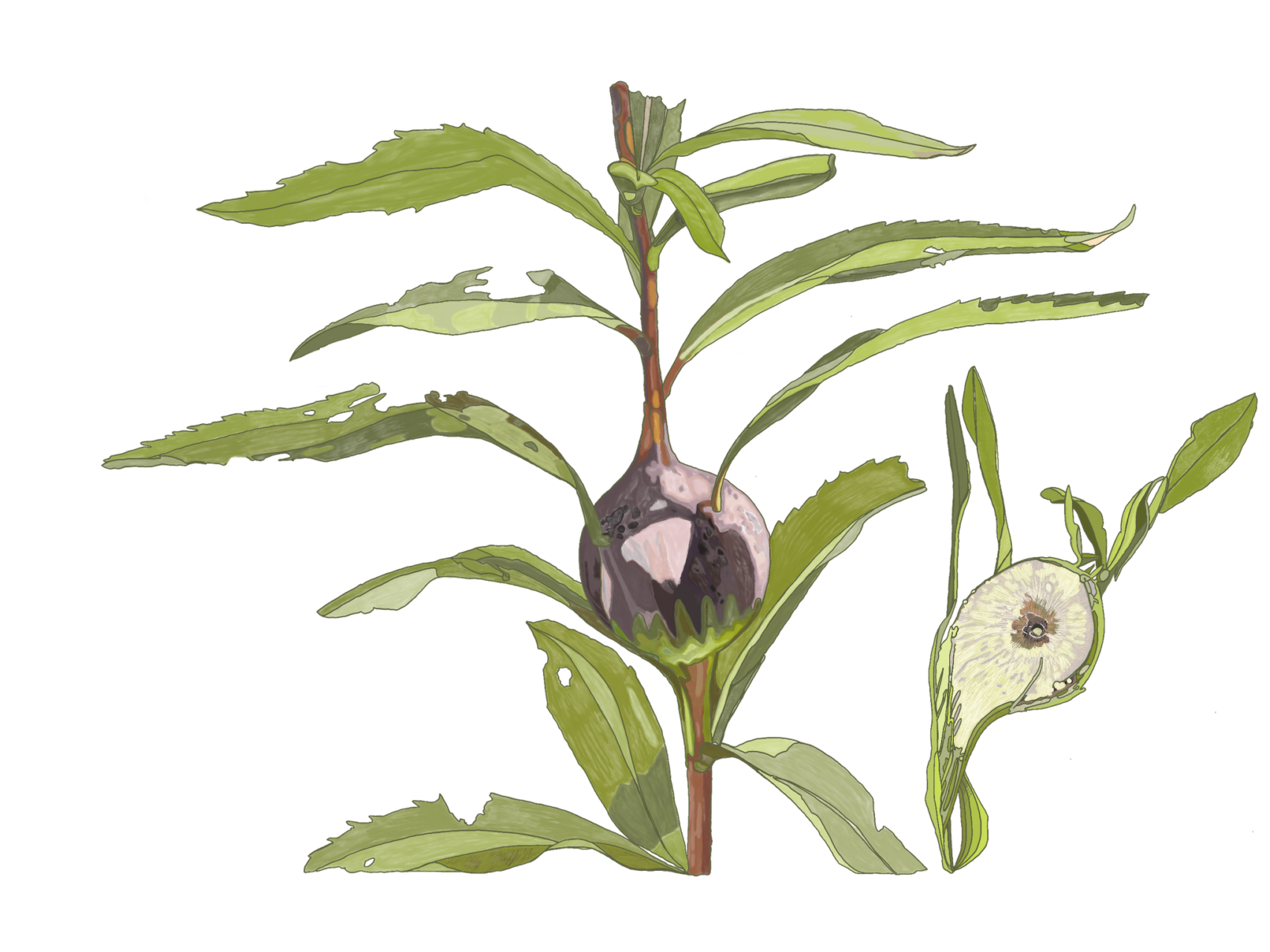
When my son was little, we often explored William O’Brien State Park together. We foraged for grapes, mushrooms, wild leeks, wild plums, and all the summer berries. We spent ample time snacking on the benches while overseeing the impressive beaver lodge construction off the aptly named Beaver Lodge Trail. We’d also battle with cattails and cast magic spells with the ball-shaped swellings on prairie stems—each of us sneaking in a satisfying thwack when we could. To us, cattails became corndogs, and those mysterious swellings transformed into magic wands in our hands. We played, and as we played, we learned.
One day, after another round of thwacking, one of us noticed a pinhead-sized dark spot near the center of the bulbous part of the prairie wand. Naturally, curiosity got the better of us, and we cut open one of the ball-shaped swellings. A little observation revealed what we’d really been holding all along: the shell of a wriggly cream-colored larva—equally gross and fascinating.
The goldenrod gall fly (Eurosta solidaginis) lays eggs on the stems of certain species of Solidago (goldenrod). The larva forms a gall around itself as it feeds on the tissue of the plant, with the gall slowly growing and hardening as the fly larva feeds and grows. By autumn, the galls are hard as wood and protect the developing fly through winter. And this, my dear friends, is how a magic wand is made.
My son is grown up now. Whether or not he remembers that the magic wand is actually a Gall Fly is not important. My son loves the outdoors. He understands the natural world to be a complex and curious place. He knows to ask questions, look closely, and take good care of all creatures. He appreciates a good view, still loves snacks on a bench, and he understands it’s worth protecting.
Returning to the Green Door Folk School student: grace in this space matters—to both ourselves and others. Binomial nomenclature is a complex, global language system that gives every living species a unique name. Last I checked, there are over eight million species in the world.
Of course, names serve a purpose, but they are not what matters most. This participant joined the class not as a scientist, but as a writer brimming with love and curiosity for the natural world. It struck me how something as trivial as not recalling a name could hold her back. I watched her discover parasol mushrooms in the understory with the infectious delight of a five-year-old, and witnessed a palpable shift in her understanding of herself and her role in a complex, interconnected system. This transformation unfolded as she compared the cellular structure of a plant stem to that of her own skin cells, peering through a magnifying tool intended for elementary school children. Names were not part of this transformation.
What is true for my son, for myself, and for this student: unencumbered awe and wonder must come first; the study comes later.
Magic wand it is.
Jessica Turtle is a public artist, educator, program designer, and Master Naturalist. She is founder of Treehaus Studio in Osceola and co-founder of Paddlefish Adventures. Her multimedia work can be seen throughout the St. Croix Valley and Twin Cities area. She recently completed a sculpture at Wild River State Park and has created large murals in Luck, Wisconsin; White Bear Center for the Arts;the University of St. Thomas; and beyond. Learn more at https://jessicaturtle.org/.
St. Croix 360 offers commenting to support productive discussion. We don’t allow name-calling, personal attacks, or misinformation. This discussion may be heavily moderated and we reserve the right to block nonconstructive comments. Please: Be kind, give others the benefit of the doubt, read the article closely, check your assumptions, and stay curious. Thank you!
“Opinion is really the lowest form of human knowledge. It requires no accountability, no understanding.” – Bill Bullard
Whoops! There was an error and we couldn't process your subscription. Please reload the page and try again.
By clicking subscribe, you agree to share your email address with St. Croix 360 and Mailchimp to receive emails from St. Croix 360. We will never share your information with anyone else.



Comment