A lengthy article published in the Minneapolis Sunday Tribune more than a hundred years ago was penned by a woman who would later become a close friend and confidant of First Lady Eleanor Roosevelt. Reporter Lorena Hickok wrote the largely humorous story after a three-day trip from Taylors Falls to Stillwater in 1921.
St. Croix 360 is pleased to republish this article as a series. (See the introduction to part one for more information about Lorena Hickok’s remarkable life.)
Last week’s installment ended with the paddlers finally bedding down for their first night at a hotel in Osceola. This final part describes the rest of their trip to Stillwater, including an overnight stay in Marine on St. Croix.
Part 3: If Girl Reporter Had Known—Canoeing’s One Thing, Paddling’s Another
The Minneapolis Sunday Tribune Sunday, September 11, 1921 Lorena Hickok (No byline)
The Girl Reporter paddled the next morning.
It might have been a delightful forenoon—it was a perfect day, the scenery was gorgeous, and there was just one sandbar bad enough they all had to get out—yes, it might have been a delightful forenoon, if the girl friend and the friend hadn’t been seized with an ambition to catch a fish.
That drove them into the treacherous water close by the shore—logs, rocks, big branches of fallen trees, a thousand and one perils that filled the Girl Reporter’s very soul with terror.
It was bad enough from the start. More than half the time she knew—she just knew they were headed for destruction.
They would glide by one peril, when another would loom up a rod or so ahead of the canoe, and then the Girl Reporter would gasp:
“A-a-a-a-a little to the r-r-r-right! It—it—it’s a d-d-d-d-dead-head!”
Then the girl friend got a bass on her trolling hook. Immediately, the friend was no longer interested in steering past dead-heads—and the Girl Reporter and the Muller III, left to their own devices, were helpless—they didn’t have any devices!
“Steady, there! Steady! Give ‘er play! Don’t rush ‘er” The friend’s eyes were on the line.
“Hey, it’s a—it’s a—it’s a d-d-dead—”
“Yep, she’s a bass,” announced the friend, cheerfully, cutting in on the Girl Reporter’s warning.
“Now! Easy there—easy—”
Yep, It Was!
“Crash! Bang! Slap!”
The Muller III ran into a log, and a cold wet fish hit the Girl Reporter squarely between the shoulder blades simultaneously. The Muller III trembled, rocked—but didn’t upset. The friend hauled out his pocket knife and made a lunge at the fighting “sea monster.”
It was a hard 10 minutes for the Girl Reporter.
They had just got out of that difficulty and were fairly well out from shore, and the Girl Reporter had just given a sigh of relief because she didn’t have to worry about anything but sand-bars now, when the girl friend sighted a spring.
That meant traversing an uncharted sea again—more dead-heads. The Girl Reporter was in a cold sweat by the time they got up to the spring. And she choked on a cup of the delicious cold water—conjecturing as their possible fate when they tried to get out of the place.
To get depth, they had to keep out away from shore for some distance now.
The sun beat down unmercifully. The Girl Reporter didn’t mind that as much, however—she wanted to get sun-burnt. So she rolled up her sleeves, turned down her collar, and took off her hat—and let ’em burn.
It grew hotter and hotter, and the canoe paddle grew heavier and heavier, and the Girl Reporter’s shoulder ached. She was gaining form in the business of poling off sand-bars—but she somehow lacked confidence in herself and the Muller III.
“Keep an eye out of shallow water up ahead, and you’ll save us a lotta work,” counseled the friend.
The water of the St. Croix is brown and soupy. The Girl Reporter couldn’t even see the end of her paddle in the water—let alone a sand-bar.
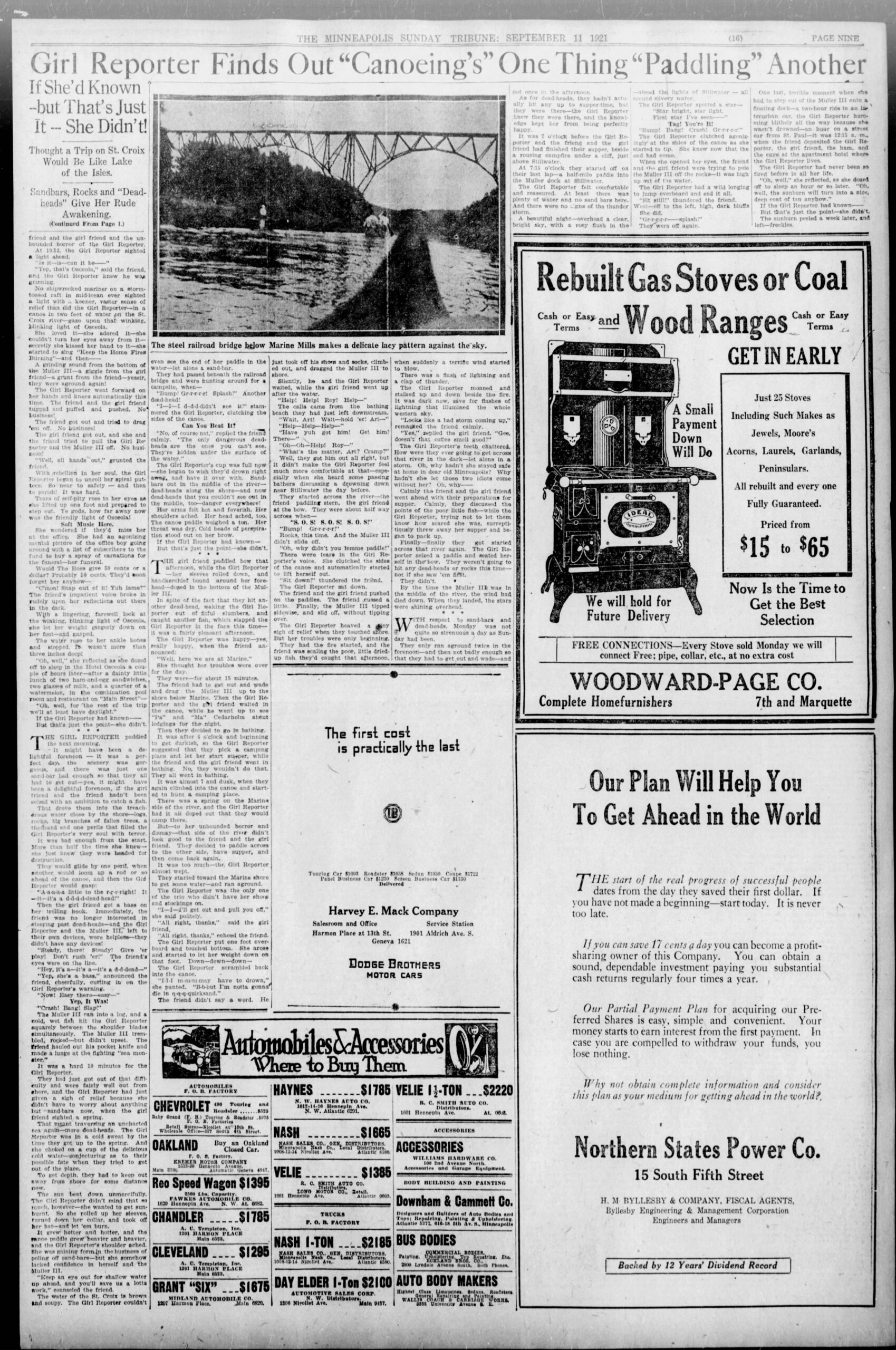
They had passed beneath the railroad bridge and were hunting around for a campsite when—
“Bump! Gr-r-r-r-r! Splash!” Another dead-head!
“I—I—I d-d-d-didn’t see it!” stammered the Girl Reporter, clutching the sides of the canoe.
Can You Beat It?
“No, of course not,” replied the friend calmly. “The only dangerous dead-heads are the ones you can’t see. They’re hidden under the surface of the water.”
The Girl Reporter’s cup was full now—she began to wish they’d drown right away, and have it over with. Sand-bars out in the middle of the river—dead-heads along the shore—and now dead-heads that you couldn’t see out in the middle, too—danger everywhere!
Her arms felt hot and feverish. Her shoulders ached. Her head ached, too. The canoe paddle weighed a ton. Her throat was dry. Cold beads of perspiration stood out on her brow.
If the Girl Reporter had known—
But that’s just the point—she didn’t.
* * *
The girl friend paddled bow that afternoon, while the Girl Reporter—her sleeves rolled down, and handkerchief bound around her forehead—dozed in the bottom of the Muller III.
In spite of the fact that they hit another dead-head, waking the Girl Reporter out of fitful slumbers, and caught another fish, which slapped the Girl Reporter in the fact this time—it was a fairly pleasant afternoon.
The Girl Reporter was happy—yes, really happy, when the friend announced:
“Well, here we are at Marine.”
She thought her troubles were over for the day.
They were—for about 15 minutes.
The friend had to get out and wade and drag the Muller III up to the shore below Marine. Then the Girl Reporter and the girl friend waited in the canoe, while he went up to see “Pa” and “Ma” Cedarholm about lodgings for the night.
Then they decided to go in bathing.
It was after 6 o’clock and beginning to get darkish, so the Girl Reporter suggested that they pick a camping place and let her start supper, while the friend and girl friend went in bathing. No, they wouldn’t do that. They all went in bathing.
It was almost 7 and dusk, when they again climbed into the canoe and started to hunt a camping place.
There was a spring on the Marine side of the river, and the Girl Reporter had it all doped out that they would camp there.
But—to her unbounded horror and dismay—that side of the river didn’t look good to the friend and the girl friend. They decided to paddle across to the other side, have supper, and then come back again.
It was too much—the Girl Reporter almost wept.
They started toward the Marine shore to get some water—and ran aground.
The Girl Reporter was the only of the trio who didn’t have her shoes and stockings on.
“I—I—I’ll get out and pull you off,” she said politely.
“All right, thanks,” said the girl friend.
“All right, thanks,” echoed the friend.
The Girl Reporter put one foot overboard and touched bottom. She arose and started to let her weight down on that foot. Down—down—down—
The Girl Reporter scrambled back into the canoe.
“I-I-I m-m-m-may have to drown,” she panted. “B-b-but I’m not gonna die in q-q-q-quicksand.”
The friend didn’t say a word. He just took off his shoes and socks, climbed out, and dragged the Muller III to shore.
Silently, he and the Girl Reporter waited, while the girl friend went up after the water.
“Help! Help! Roy! Help—”
The calls came from the bathing beach they had just left downstream.
“Wait, Art! Walt—hold ‘er! Art—”
“Help—Help—Help—”
“Have yuh got him! Get him! There—”
“Oh—Oh—Help! Roy—”
“What’s the matter, Art? Cramp?”
Well, they got him out all right, but it didn’t make the Girl Reporter feel much more comfortable at that—especially when she heard some passing bathers discussing a drowning near Stillwater the day before.
They started across the river—the friend paddling stern, the girl friend at the bow. They were about half way across when—
“S.O.S! S.O.S! S.O.S!”
“Bump! Gr-r-r-r-r!”
Rocks, this time. And the Muller III didn’t slide off.
“Oh, why didn’t you lemme paddle?”
There were tears in the Girl Reporter’s voice. She clutched the sides of teh canoe and automatically started to lift herself out.
“Sit down!” thundered the friend.
The Girl Reporter sat down.
The friend and the girl friend pushed on the paddles. The friend cussed a little. Finally, the Muller III tipped sidewise, and slid off, without tipping over.
The Girl Reporter heaved a tiny sight of relief when they touched shore. But her troubles were only beginning.
They had the fire started, and the friend was scaling the poor, little dried-up fish they’d caught that afternoon, when suddenly a terrific wind started to blow.
There was a flash of lightning and a clap of thunder.
The Girl Reporter moaned and stalked up and down beside the fire. It was dark now, save for flashes of lightning that illumined the whole western sky.
“Looks like a bad storm coming up,” remarked the friend calmly.
“Yes,” replied the girl friend. “Gee, doesn’t that coffee smell good!”
The Girl Reporter’s teeth chattered. How were they ever going to get across the river in the dark—let alone in a storm. Oh, why hadn’t she stayed safe at home in dear old Minneapolis? Why hadn’t she let those two idiots come without her? Oh, why—
Calmly the friend and the girl friend went ahead with their preparations for supper. Calmly, they discussed the points of the poor little fish—while the Girl Reporter, trying not to let them know how scared she was, surreptiously threw away her supper and began to pack up.
Finally—finally they got started across that river again. The Girl Reporter seized a paddle and seated herself in the bow. They weren’t going to hit any dead-heads or rocks this time—not if she ’em first.
They didn’t.
By the time the Muller III was in the middle of the river, the wind had died down. When they landed, the stars were shining overhead.
* * *
With respect to sand-bars and dead-heads. Monday was not quite so strenuous a day as Sunday had been.
They only ran aground twice in the forenoon—and then not badly enough so that they had to get out and wade—and not once in the afternoon.
As for dead-heads, they hadn’t actually hit any up to supper-time, but they were there—the Girl Reporter knew they were there, and the knowledge kept her from being perfectly happy.
It was 7 o’clock before the Girl Reporter and the friend and the girl friend had finished their supper, beside a rousing campfire under a cliff, just above Stillwater.
At 7:15 o’clock they started off on their last lap—a half-mile paddle into the Muller dock at Stillwater.
The Girl Reporter felt comfortable and reassured. At least there was plenty of water and no sand bars here. And there were no signs of the thunder storm.
A beautiful night—overhead a clear, bright sky, with a rosy flush in the [sic] —ahead the lights of Stillwater—all around silvery water.
The Girl Reporter spotted a star—
“Star bright, star light,
First star I’ve seen—”
Tag! You’re It!
“Bump! Bang! Crash! Gr-r-r-r-r”
The Girl Reporter clutched agonizingly at the sides of the canoe as she started to tip. She knew now that the end had come.
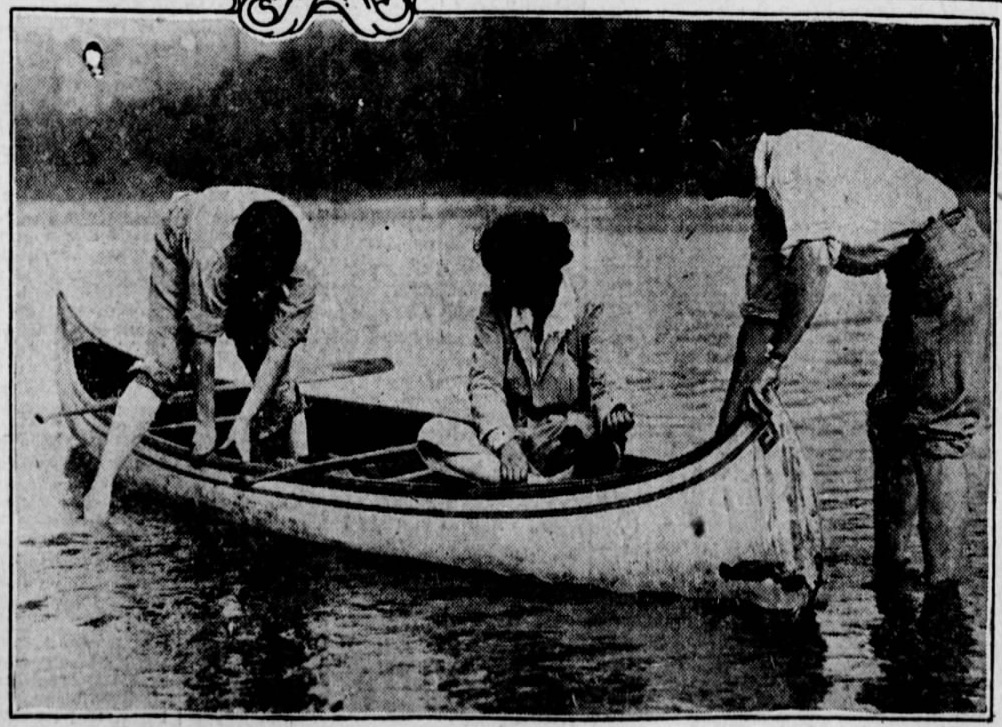
When she opened her eyes, the friend and the girl friend were trying to pole the Muller III off the rocks—it was up out of the water.
The Girl Reporter had a wild longing to jump overboard and end it all.
“Sit still!” thundered the friend.
West—off to the left, high, dark bluffs
She did.
“Gr-r-r-r-r—splash!”
They were off again.
One last, terrible moment when she had to step out of the Muller III onto a floating dock—a two-hour ride in an interurban car, the Girl Reporter humming blithely all the way because she wasn’t drowned—an hour on a street car from St. Paul—it was 12:15 a.m., when the friend deposited the Girl Reporter, the girl friend, the ham, and the eggs at the apartment hotel where the Girl Reporter lives.
The Girl Reporter had never been so tired in all her life.
“Oh, well,” she reflected, as she dozed off to sleep an hour or so later. “Oh, well, the sunburn will turn into a nice, deep coat of tan anyhow.”
If the Girl Reporter had known—
But that’s just the point—she didn’t.
The sunburn peeled a week later, and left—freckles.
St. Croix 360 offers commenting to support productive discussion. We don’t allow name-calling, personal attacks, or misinformation. This discussion may be heavily moderated and we reserve the right to block nonconstructive comments. Please: Be kind, give others the benefit of the doubt, read the article closely, check your assumptions, and stay curious. Thank you!
“Opinion is really the lowest form of human knowledge. It requires no accountability, no understanding.” – Bill Bullard
Whoops! There was an error and we couldn't process your subscription. Please reload the page and try again.
By clicking subscribe, you agree to share your email address with St. Croix 360 and Mailchimp to receive emails from St. Croix 360. We will never share your information with anyone else.





Comment