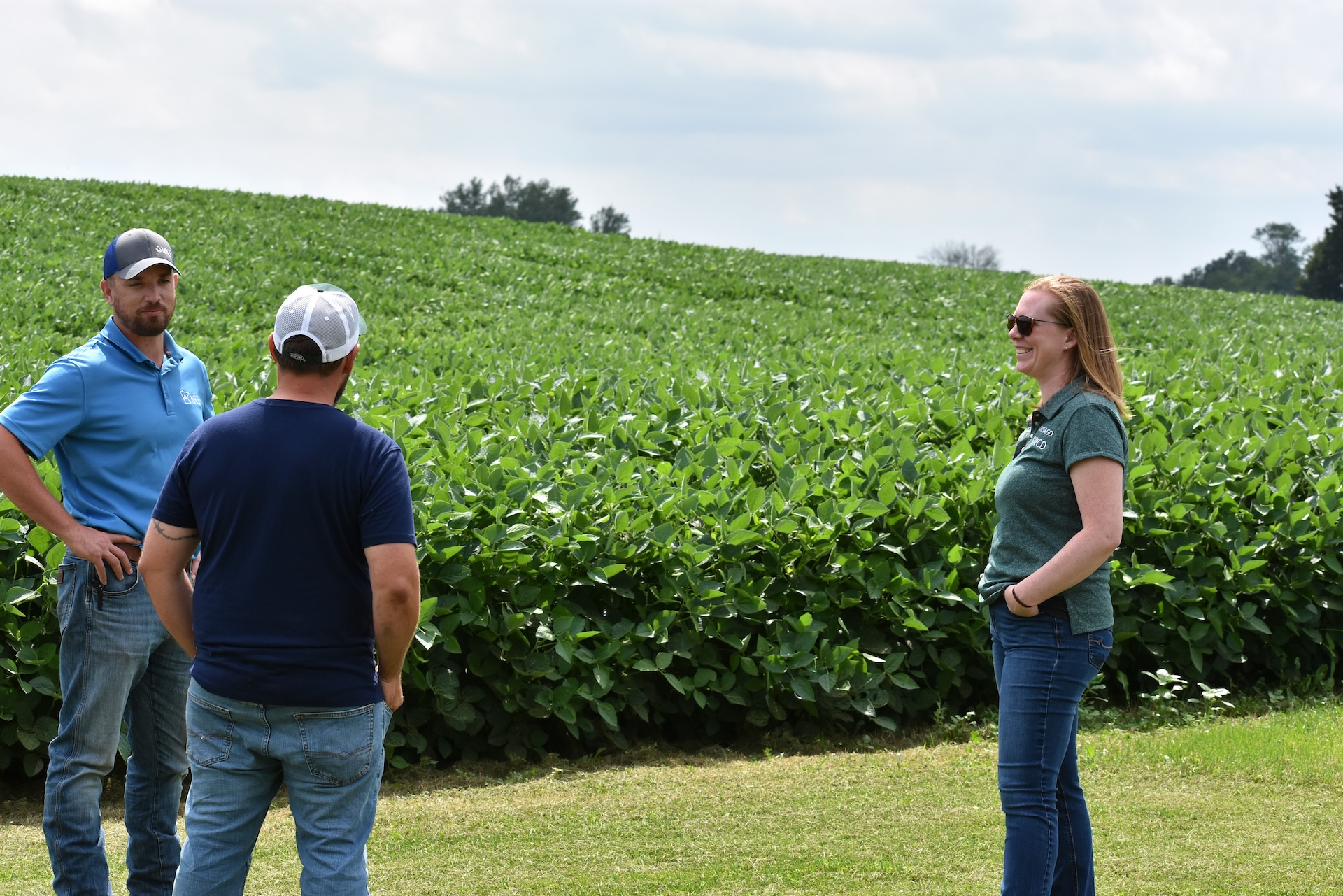
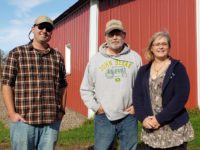
Chisago SWCD conservation specialist Jacquelynn Olson, Chisago County producer Sonny Strelow and NRCS District Conservationist Team Lead Brian Steffen discussed the conservation projects and practices Strelow implemented through the Mississippi River Basin Initiative. (Ann Wessel/BWSR)
The conservation projects and practices sixth-generation Chisago County farmer Sonny Strelow has implemented in recent years with state and federal assistance targeting the St. Croix and Mississippi rivers are meant to improve the land on the family farm, which is marking its 150th year.
“For the next generation and beyond, I would like to see this place be able to continue farming,” Strelow said. “We’ve got to look past when we’re gone (to) what happens after.”
For Strelow, that has meant installing water and sediment control basins to curb erosion. It’s meant improving soil health via cover crops and no-till practices, which cut fuel costs and save time.
Keeping topsoil and nutrients in the fields carries water quality benefits that extend from Strelow’s farm — some of the hilliest land in the Goose Creek watershed — all the way to the Gulf of Mexico.
Water quality concerns, mostly related to nutrient-loading, prompted the USDA’s Natural Resources Conservation Service (NRCS) to make the Mississippi River a priority. Launched in 2009, the 12-state Mississippi River Basin Initiative (MRBI) taps several Farm Bill programs, including the Environmental Quality Incentives Program (EQIP) and the Agricultural Conservation Easement Program, to help landowners sustain natural resources through voluntary conservation.
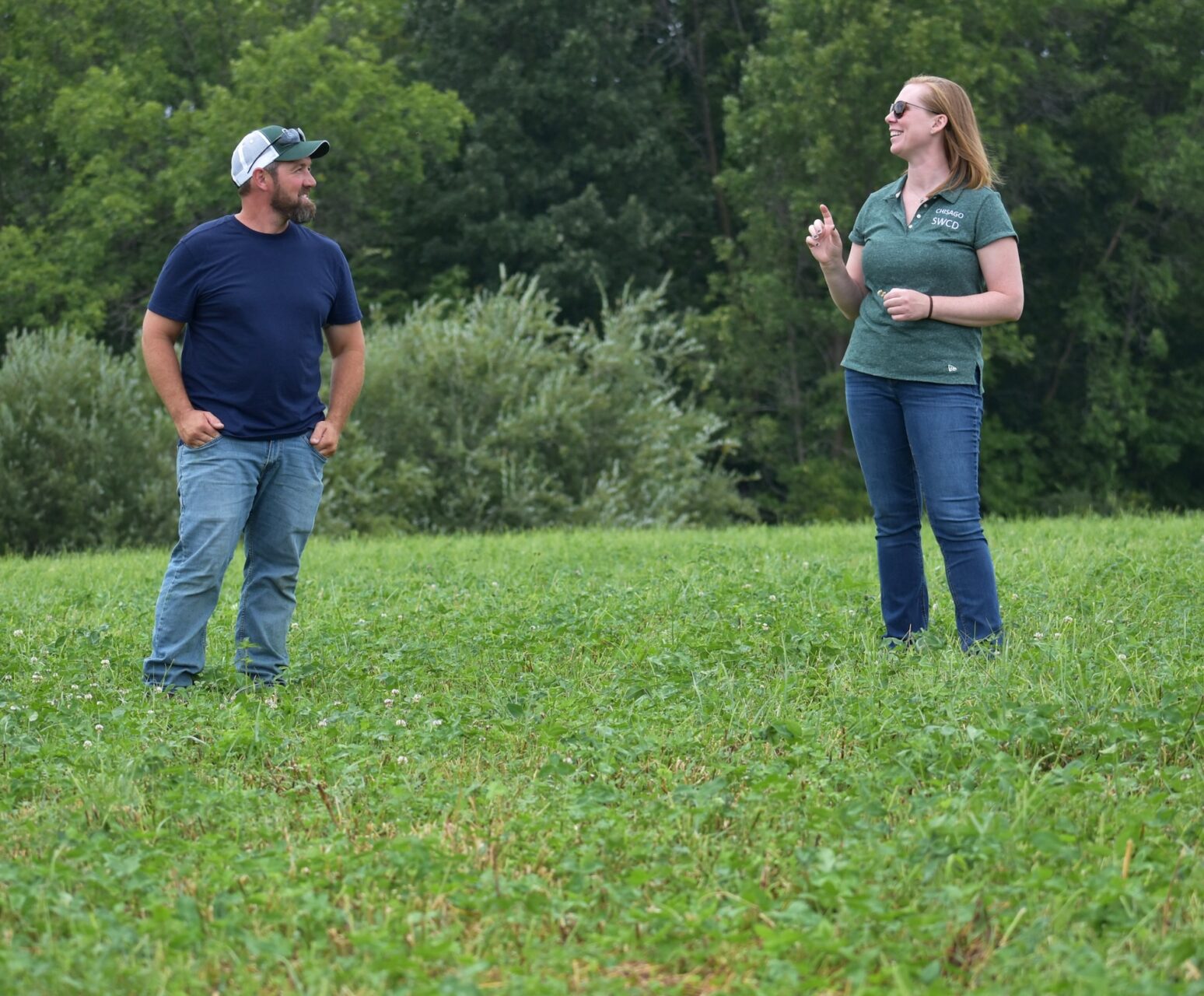
Chisago SWCD conservation specialist Jacquelynn Olson and Chisago County producer Sonny Strelow discussed his cattle operation during an August 2025 visit to the field he converted from row crops to hay with assistance from federal Mississippi River Basin Initiative and state Clean Water Fund support. (Ann Wessel/BWSR)
The Chisago SWCD in 2021 received an MRBI award that brought dedicated, noncompetitive funding to the Goose Creek watershed, which includes Goose Lake, Rush Lake and Rush Creek.
“Anything that we can do in this watershed has a trickle-down effect impacting the water quality downstream, and we want to do everything that we can to reduce the pollutants that we send downstream,” said Chisago SWCD conservation specialist Jacquelynn Olson, who works directly with landowners.
Heavy agricultural density, with the potential for nitrogen and phosphorus to reach those lakes, made the watershed a priority, said NRCS District Conservationist Team Lead Brian Steffen, who is now based in Waite Park. The 140-square-mile Goose Creek watershed work area drains to the Mississippi by way of the St. Croix River.
The Goose Creek MRBI involved 34 people, 39 contracts and $289,795 in federal EQIP assistance, supporting work totaling more than $708,000.
Among the resulting projects and practices: about 370 acres of cover crops, 80 acres of no-till, 30 acres of conservation cover; 90 acres of pasture and hay plantings, five watering facilities, one well, one pumping station; and 43 water and sediment control basins.
The SWCD tapped two competitive Clean Water Fund grants from the Minnesota Board of Water and Soil Resources (BWSR), leveraging $417,020 in state funds to cover 100% of EQIP-supported Goose Creek MRBI projects. A $1,000 Rush Lake Improvement Association contribution and a $250 landowner’s contribution brought the total to $708,065.
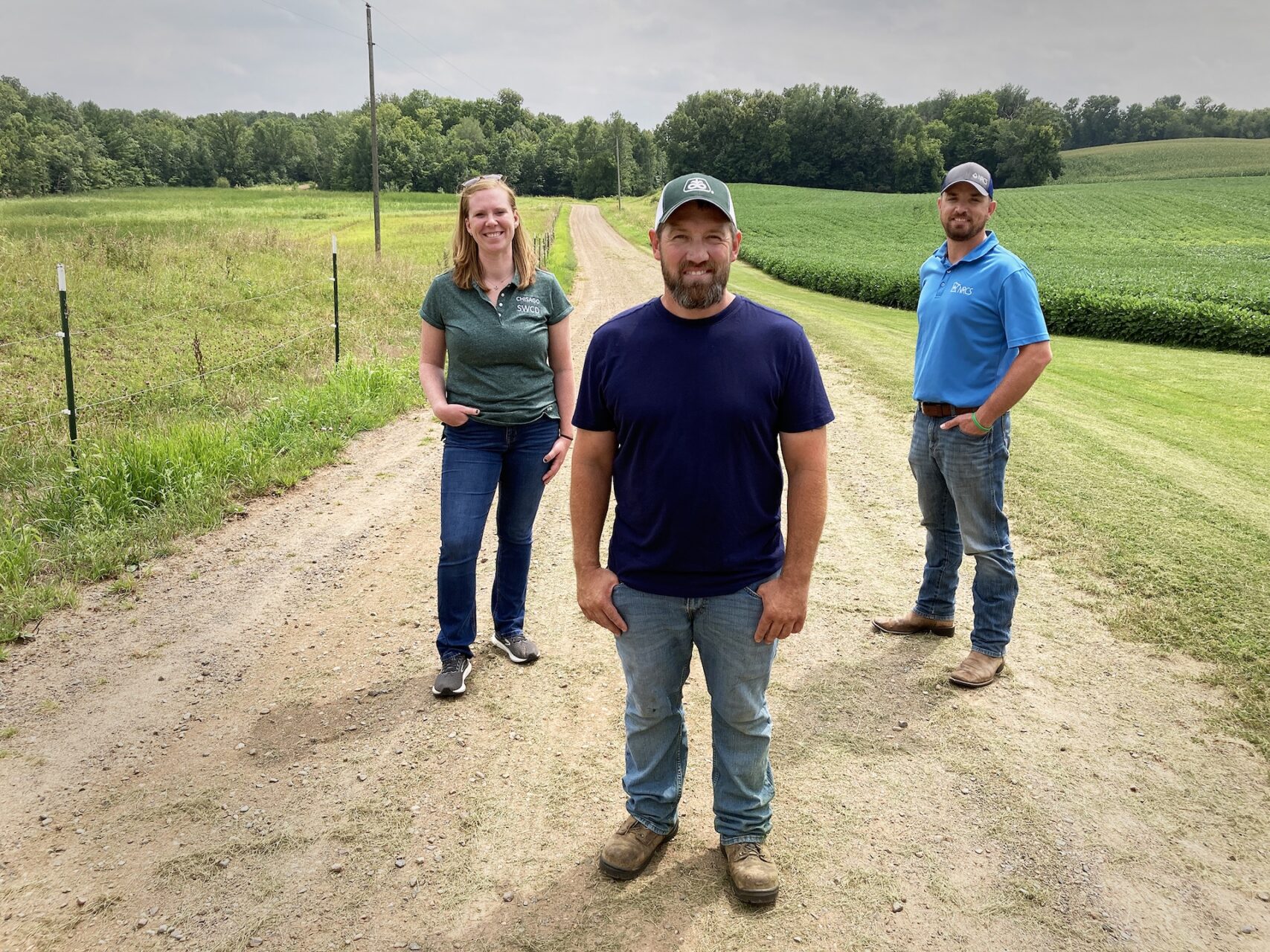
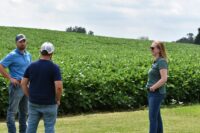
From left: Chisago SWCD conservation specialist Jacquelynn Olson, Chisago County producer Sonny Strelow and NRCS District Conservationist Team Lead Brian Steffen discussed the conservation projects and practices Strelow implemented through the Mississippi River Basin Initiative. (Ann Wessel/BWSR)
“If they had to fund the whole project, that’s a huge out-of-pocket expense. They’d probably continue just bringing that soil back up and just leveling off the field instead of fixing the problem,” Steffen said of the water and sediment control basins.
“Every little practice helps. It’s not the big ones. It’s not the small ones. It’s everything combined and in between,” Steffen said.
Through a 2023 NRCS contract, Strelow installed four water and sediment control basins in a field he rented. He said the structures effectively controlled erosion, but the farmable basin was a bit steep.
“We’ve gained at least 2 acres out of the center of (that) field that were normally unfarmable on a year like this, which doesn’t sound like a lot but when you’re considering your passes up and down, you’re not turning around (at a) low spot, it makes a big difference,” Strelow said in 2025.
Through a 2024 contract, Strelow installed a grassed water and sediment control basin at the home site. Additionally, with MRBI and Clean Water Fund assistance, in 2024 he no-tilled 52 acres. In 2025 he no-tilled an additional 26 acres, planting soybeans into spring wheat.
“It worked really good. I was surprised, and even more surprising were the soybeans that followed the wheat the third year. They were better than the (first year of the 3-year contract) by 5 or 6 bushels an acre at least,” Strelow said in fall 2026.
“I had no washouts in that field,” Strelow said. “It was as smooth as the year I planted it.”
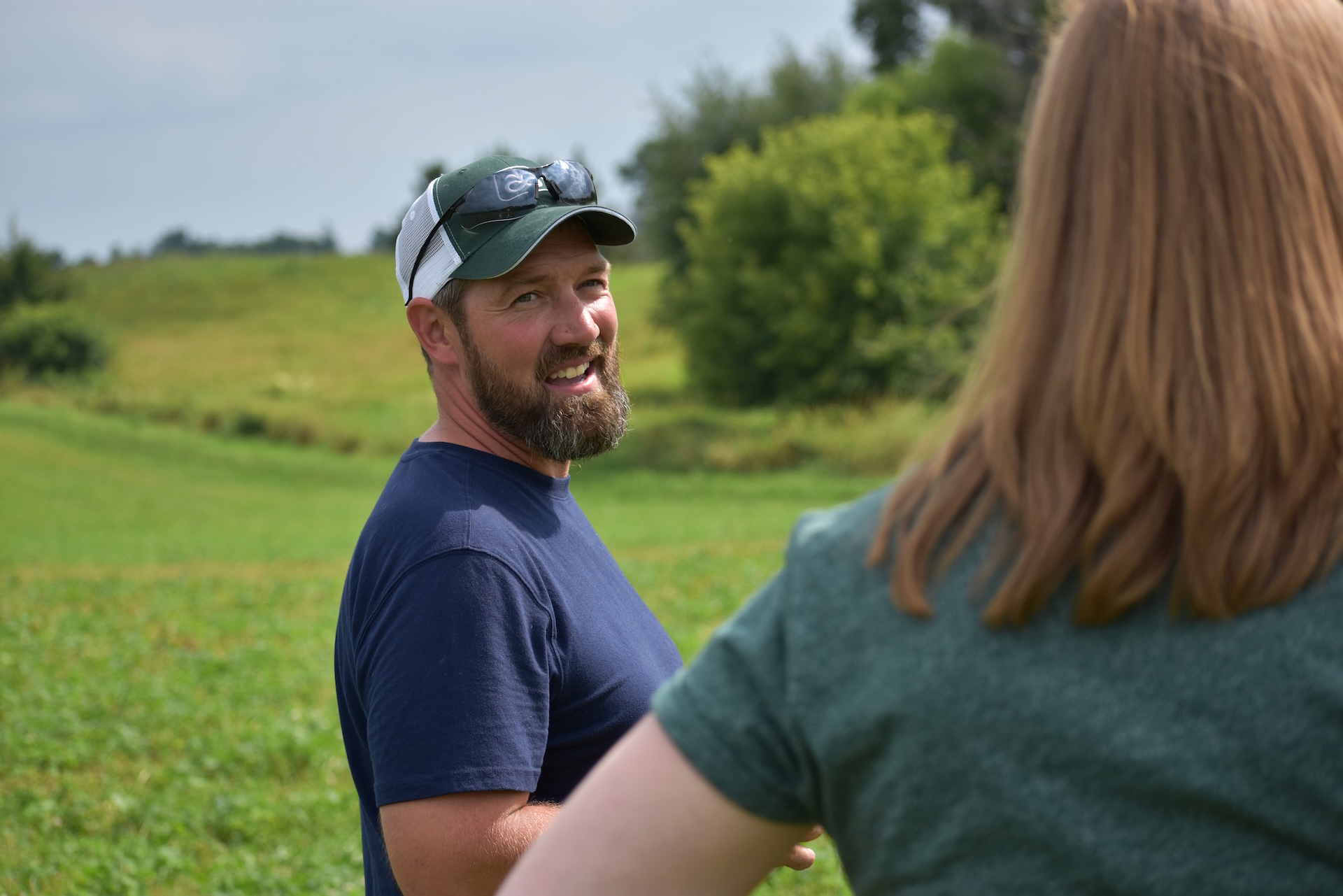
Chisago County producer Sonny Strelow discussed his cattle operation during an August 2025 visit to the field he converted from row crops to hay with assistance from federal Mississippi River Basin Initiative and state Clean Water Fund support. (Ann Wessel/BWSR)
On his own, Strelow increased the acreage planted into cover crops. His own research and working with the SWCD and NRCS allayed concerns about trying cover crops with a shorter growing season and on clay soils.
“The cover crops worked really well. We seeded rye onto existing wheat stubble and went right into that. It was a great stand in the spring,” Strelow said.
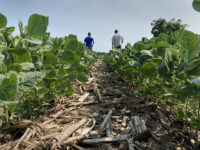
He then planted soybeans into waist-high rye, a cover crop that was sprayed the same day the beans were planted. That soybean crop yielded 40 to 45 bushels an acre in 2025. The yield averages weren’t in yet for the 2026 soybean harvest, which finished in mid-October. While the drought affected this year’s yield, Strelow said no-tilling helped to preserve soil moisture in the spring.
“I would hate to have seen how terrible they would have looked had I tilled that field,” Strelow said.
“We were 100% conventional tillage,” Strelow said. “If you can figure out a way to cut some costs, it does matter. So if you can keep your yield close — it doesn’t have to be perfect — but you’re already eliminating a pass and you’re eliminating fuel costs.”
Now, Strelow is moving away from row crops to focus on his grazing operation.
With MRBI and Clean Water Fund assistance, in 2024 he converted nearly 25 acres of hilly row crops to hay. He’s committed to keeping the field in permanent cover for 10 years.
“When we can convert a row-crop field into perennial cover, that has a huge impact on reducing soil erosion in the long term,” Olson said.
St. Croix 360 offers commenting to support productive discussion. We don’t allow name-calling, personal attacks, or misinformation. This discussion may be heavily moderated and we reserve the right to block nonconstructive comments. Please: Be kind, give others the benefit of the doubt, read the article closely, check your assumptions, and stay curious. Thank you!
“Opinion is really the lowest form of human knowledge. It requires no accountability, no understanding.” – Bill Bullard
Whoops! There was an error and we couldn't process your subscription. Please reload the page and try again.
By clicking subscribe, you agree to share your email address with St. Croix 360 and Mailchimp to receive emails from St. Croix 360. We will never share your information with anyone else.





Comment