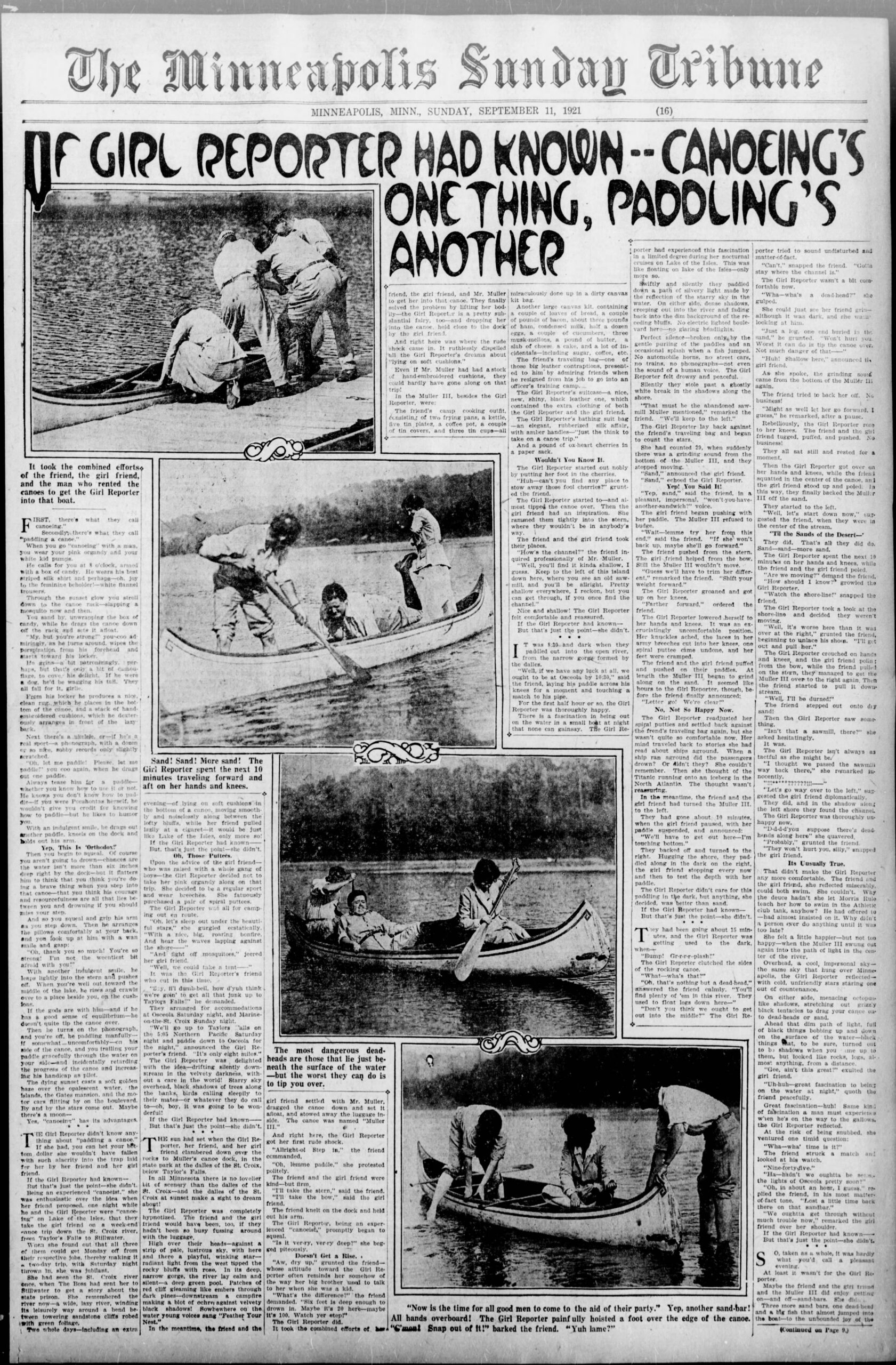
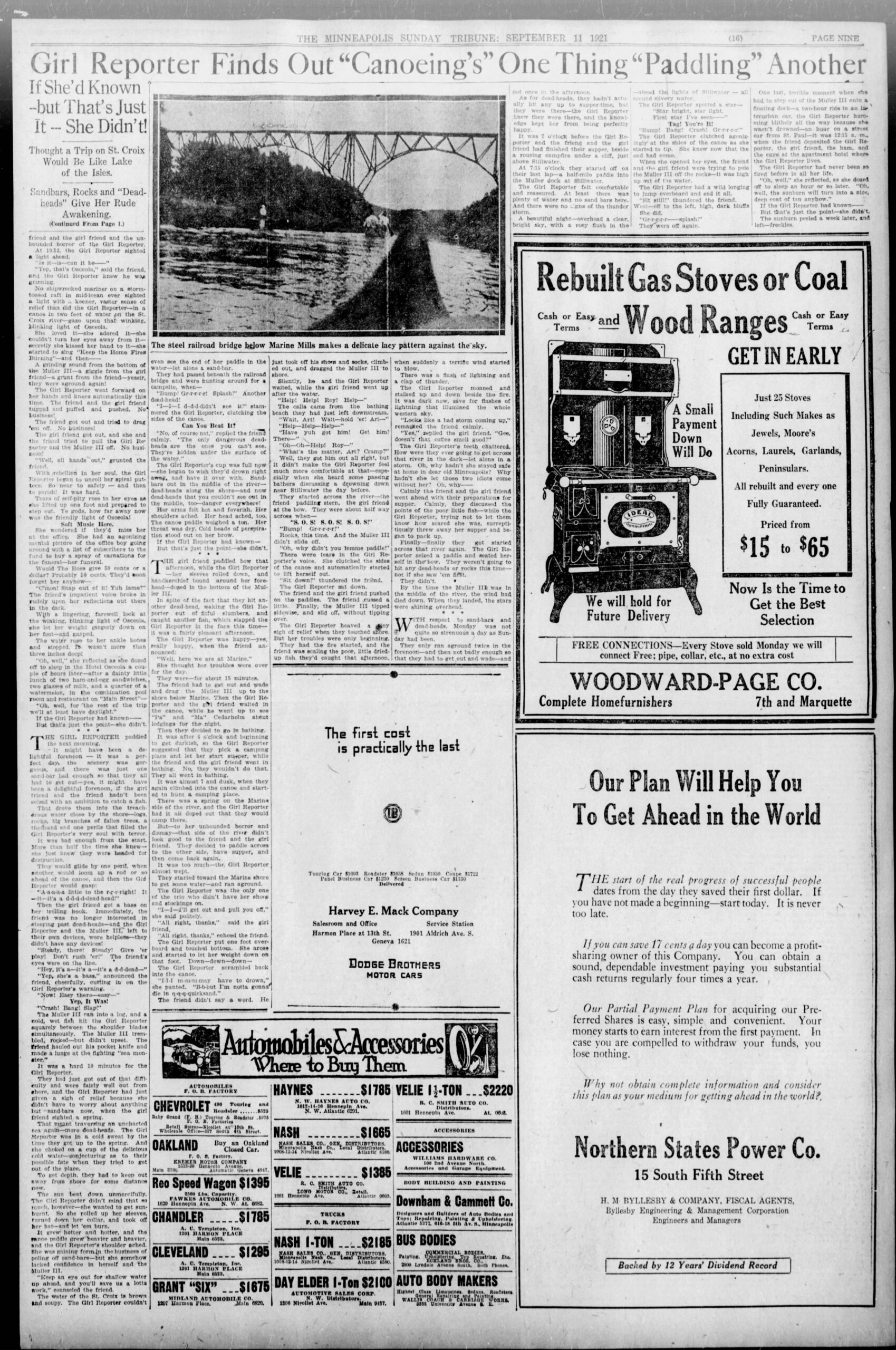
A lengthy article published in the Minneapolis Sunday Tribune more than a hundred years ago was penned by a woman who would later become a close friend and confidant of First Lady Eleanor Roosevelt. Reporter Lorena Hickok wrote the largely humorous story after a three-day trip from Taylors Falls to Stillwater in 1921.
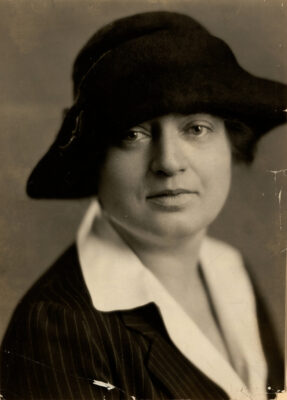
Hickok did not have her byline on the article, instead identified only as the “Girl Reporter.” But Hickok was a pioneering journalist who made a successful career of reporting between 1912 and 1932—when covering the Roosevelts during Franklin Delano Roosevelt’s first presidential campaign turned into a friendship that made it impossible for her to continue objective work.
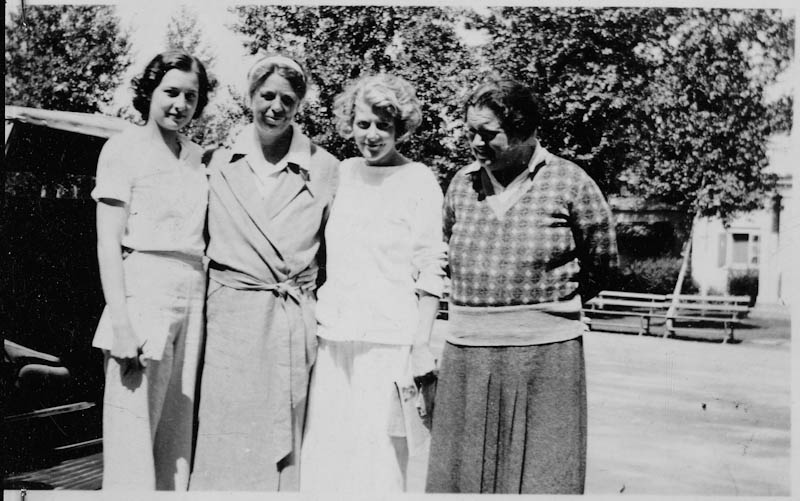
During the rest of Hickok’s life, she was a friend and possibly romantic partner of Eleanor Roosevelt. In the 1930s, she traveled to more than 30 states to assess living conditions during the Great Depression. From 1941 to 1945, during the height of World War II, Hickok lived at the White House in a bedroom next to Eleanor’s. The friendship was documented in 3,000 letters sent between them that Hickok left to the Roosevelt Library on her death at the Roosevelts’ estate named Hyde Park in 1968.
Hickok was born in 1893 in East Troy, Wisconsin to a buttermaker who was abusive and neglectful, and a mother was passed away when Lorena was 13. Essentially abandoned by her father and his new wife, Hickok spent the next few years working as hired help in several different households. Thanks to a caring cousin, she eventually ended up in Chicago and then Battle Creek, Michigan, where she finally finished high school.
After graduating, Hickok got a job as a reporter for the Battle Creek Evening News, and then moved on to the Milwaukee Sentinel. In 1917, she moved to Minnesota for a job at the Minneapolis Tribune. She covered politics and hard news for the Tribune, as well as being one of the first women to cover sports, but it was a farcical canoeing adventure in late summer four years later that brings her to our attention.
The article is full of humorous foreshadowing of a calamity (that never really arrives), self-deprecating jokes, and a general discomfort with the Great Outdoors. It displays outdated ideas about gender roles, representing conflicts Hickok knew about firsthand as a gay woman who did not fit into the femininity typical of the time. Her report on the river trip may not have done much to sell the idea to other potential paddlers, but it provides a unique look at the river during the beginning of the Roaring Twenties.
Not only does Hickok only refer to herself in the third person and anonymously, she refers to her two companions as “the friend” and “the girl friend.” It is possible that the girl friend was newspaper society reporter Ella Morse, with whom Hickok lived and had an eight-year relationship during this time.
St. Croix 360 is pleased to republish this article as a series over the coming weeks.
If Girl Reporter Had Known—Canoeing’s One Thing, Paddling’s Another (Part 1)
The Minneapolis Sunday Tribune Sunday, September 11, 1921 Lorena Hickok (No byline)
Lorena Hickok, 1926 (Courtesy Hennepin County Library)
First, there’s what they call canoeing.
Secondly, there’s what they call “paddling a canoe.”
When you go “canoeing” with a man, you wear your pink organdy and your white kid pumps.
He calls for you at 8 o’clock, armed with a box of candy. He wears his best striped silk shirt and perhaps—oh, joy to the feminine beholder!—white flannel trousers.
Through the sunset glow you stroll down to the canoe rack—slapping a mosquito now and then.
You stand by, unwrapping the box of candy, while he drags the canoe down off the rack and sets it afloat.
“My, but you’re strong!” you coo admiringly, as he turns around, wipes the perspiration from his forehead and starts toward his locker.
He grins—a tad patronizingly, perhaps, but that’s only a bit of camouflage, to cover his delight. If he were a dog, he’d be wagging his tail. They all fall for it, girlie.
From his locker he produces a nice clean rug which he places in the bottom of the canoe, and a stack of hand-embroidered cushions, he dexterously arranges in front of the lazy-back.
Next there’s a ukelele, or—if he’s a real sport—a phonograph, with a dozen or so nice, sobby records only slightly scratched.
“Oh, let me paddle! Please, let me paddle!” you coo again, when he drags out one paddle.
Always tease him for a paddle—whether you know how to use it or not. He knows you don’t know how to paddle—if you were Pocahontas herself, he wouldn’t give you credit for knowing how to paddle—but he likes to humor you.
With an indulgent smile, he drags out another paddle, kneels down on the dock and holds out his arm.
Yep, This is ‘Orthodox!’
Eleanor Roosevelt (second from left), Lorena Hickok (right), and two unidentified women, 1933. (FDR Presidential Library)
Then you begin to squeal. Of course you aren’t going to drown—chances are the water isn’t more than six inches deep right by the dock—but it flatters him to think that you think you’re doing a brave thing when you step into that canoe—that you think his courage and resourcefulness are all that lies between you and drowning if you should miss your step.
And so you squeal and grip his arm as you step down. Then he arranges the pillows comfortably at your back, and you look up at him with a wan smile and gasp:
“Oh, thank you so much! You’re so strong! I’m not the weentiest bit afraid with you!”
With another indulgent smile, he leaps lightly into the stern and pushes off. When you’re well out toward the middle of the lake, he rises and crawls after to a place beside you, on the cushions.
If the gods are with him—and if he has a good sense of equilibrium—he doesn’t quite tip the canoe over.
Then he turns on the phonograph, and you’re off, he paddling manfully—if somewhat uncomfortably—on his side of the canoe, and you trailing your paddle through the water on your side—and incidentally retarding the progress of the canoe and increasing his handicap as pilot.
The dying sunset casts a soft golden haze over the opalescent water, the islands, the Gates mansion, and the motor cars by flitting by on the boulevard. By and by the stars come out. Maybe there’s a moon—
Yes, “canoeing” has its advantages.
* * *
The Girl Reporter didn’t know anything about “paddling a canoe.” If she had, you can bet your bottom dollar she wouldn’t have fallen with such salacrity into the trap laid for her by her friend and her girl friend.
If the Girl Reporter had known—
But that’s just the point—she didn’t.
Being an experienced “canoeist,” she was enthusiastic over the idea when her friend proposed, one night while he and the Girl Reporter were “canoeing” on Lake of the Isles, that they take the girl friend on a week-end canoe trip down the St. Croix river, from Taylors Falls to Stillwater.
When she found out that all three of them could get Monday off from their respective jobs, thereby making it a two-day trip, with Saturday night thrown in, she was jubilant.
She had seen the St. Croix river once, when The Boss had sent her to Stillwater to get a story about the state prison. She remembered the river now—a wide, lazy river, winding its leisurely way around a bend between towering sandstone cliffs robed with green foliage.
Two whole days—including an extra evening—of lying on soft cushions in the bottom of a canoe, moving smoothly and noiselessly along between the lofty bluffs, while her friend pulled lazily at a cigaret—it would be just like Lake of the Isles, only more so!
If the Girl Reporter had known—
But that’s just the point—she didn’t.
Oh, Those Puttees.
Upon the advice of the girl friend—who was raised with a whole gang of boys—the Girl Reporter decided not to take her pink organdy along on that trip. She decided to be a regular sport and wear breeches. She fatuously purchased a pair of spiral puttees.
The Girl Reporter was all for camping out en route.
“Oh, let’s sleep out under the beautiful stars,” she gurgled ecstatically, “With a nice, big, roaring bonfire. And hear the waves lapping against the shore—”
“And fight off mosquitos,” jeered her girl friend.
“Well, we could take a tent—”
It was the Girl Reporter’s friend who cut in this time.
“Say, lil dumbbell, how d’yuh think we’re goin’ to get all that junk up to Taylors Falls,” he demanded.
They arranged for accommodations at Osceola Saturday night, and Marine-on-the-St. Croix Sunday night.
“We’ll go up to Taylors Falls on the 5:05 Northern Pacific Saturday night and paddle down to Osceola for the night,” pronounced the Girl Reporter’s friend. “It’s only eight miles.”
The Girl Reporter was delighted with the idea—drifting silently downstream in the velvety darkness, without a care in the world! Starry sky overhead, black shadows of trees along the banks, birds calling sleepily to their mates—or whatever they do call to—oh, boy, it was going to be wonderful!
If the Girl Reporter had known—
But that’s just the point—she didn’t.
* * *
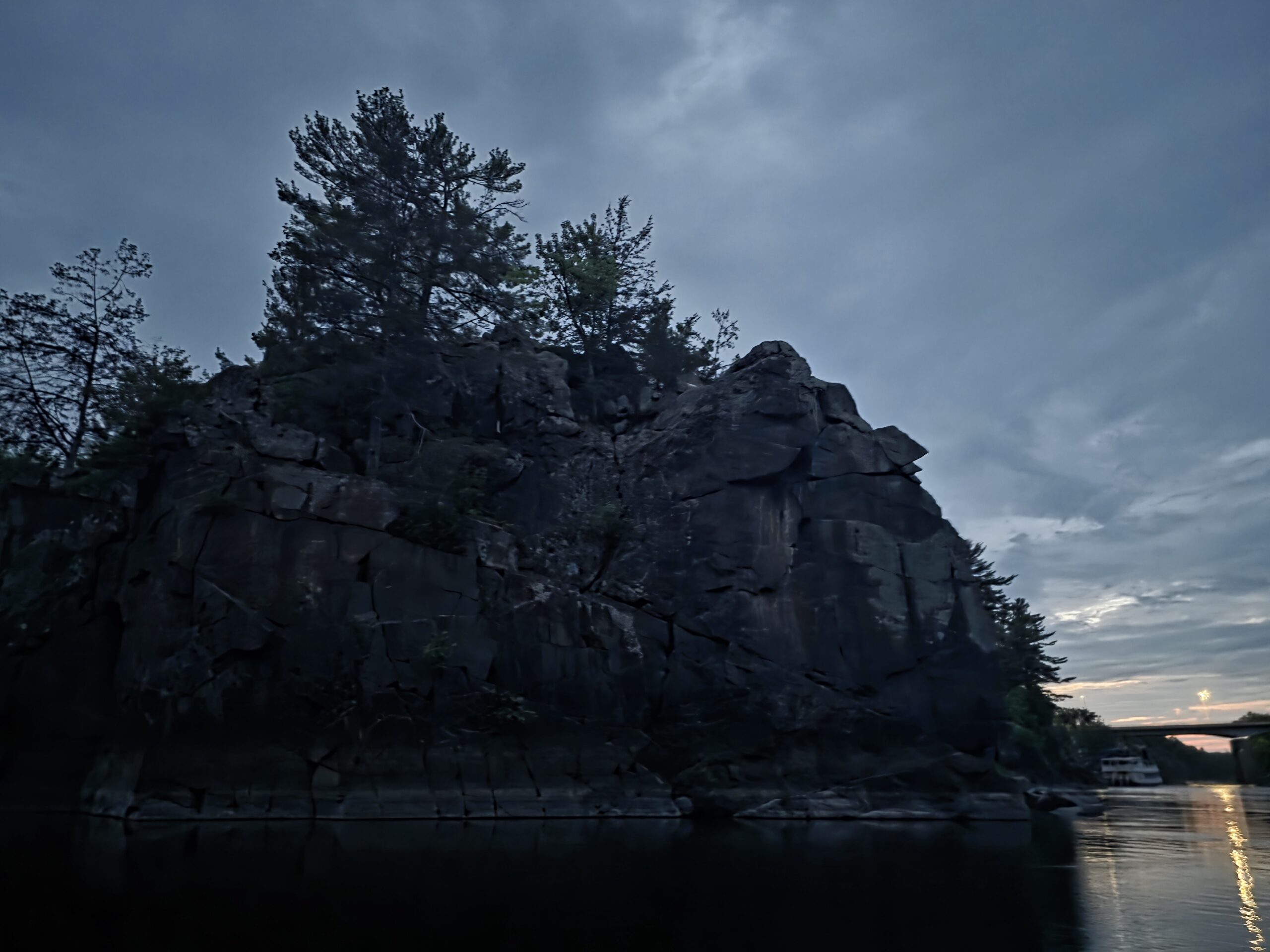
Dalles at dusk. (Greg Seitz/St. Croix 360)
The sun had set when the Girl Reporter, her friend, and her girl friend clambered down over the rocks to Muller’s canoe dock, in the state park at the dalles of the St. Croix, below Taylor’s Falls.
In all Minnesota there is no lovelier bit of scenery than the dalles of the St. Croix—and the dalles of the St. Croix at sunset make a sight to dream about!
The Girl Reporter was completely hypnotized. The friend and the girl friend would have been, too, if they hadn’t been so busy fussing around with the luggage.
High over their heads—against a strip of pale, lustrous sky, with here and there a playful, winking star—radiant light from the west tipped the rocky bluffs with rose. In its deep, narrow gorge, the river lay calm and silent—a deep green pool. Patches of red cliff gleaming like embers through dark pines—downstream a campfire making a blot of ochre against velvety black shadows! Somewhere on the water young voices sang “Feather Your Nest.”
In the meantime, the friend and the girl friend settled with Mr. Muller dragged the canoe down and set it afloat, and stowed away the luggage inside. The canoe was named “Muller III.”
And right here the Girl Reporter got her first rude shock.
“All right [?] Step in,” the friend commanded.
“Oh, lemme paddle,” she protested politely.
The friend and the girl friend were kind—but firm.
“I’ll take the stern,” said the friend.
“I’ll take the bow,” said the girl friend.
The friend knelt on the dock and held out his arm.
The Girl Reporter, being an experienced “canoeist,” promptly began to squeal.
“Is it verrry verrry deep?” she begged piteously.
Doesn’t Get a Rise.
“Aw, dry up,” grunted the friend, whose attitude toward the Girl Reporter often reminds her somehow of the way her big brother used to talk to her when she was a kid.
“What’s the difference?” the friend demanded. “Six feet is deep enough to drown in. Maybe it’s 20 here—maybe it’s 100. What yer step!”
The Girl Reporter did.
It took the combined efforts of her friend, the girl friend, and Mr. Muller to get her into that canoe. They finally solved the problem by lifting her bodily—the Girl Reporter is a pretty substantial fairy, too—and dropping her into the canoe, held close to the dock by the girl friend.
And right here was where the rude shock came in. It ruthlessly dispelled all the Girl Reporter’s dreams about “lying on soft cushions.”
Even if Mr. Muller had had a stock of hand-embroidered cushions, they could hardly have gone along on that trip!
In the Muller III, besides the Girl Reporter, were:
The friend’s camp cooking outfit, consisting of two frying pans, a kettle, five tin plates, a coffee pot, a couple of tin covers, and three tin cups—all miraculously done up in a dirty canvas kit bag.
Another large canvas kit, containing a couple of loaves of bread, a couple of pounds of bacon, about three pounds of ham, condensed milk, half a dozen eggs, a couple of cucumbers, three musk melons, a pound of butter, a slab of cheese, a cake, and a lot of incidentals—including sugar, coffee, etc.
The friend’s traveling bag—one of those big leather contraptions, presented to him by admiring friends when he resigned from his job to go into an officer’s training camp.
The Girl Reporter’s suitcase—a nice, new, shiny, black leather one, which contained the extra clothing of both the Girl Reporter and the girl friend.
The Girl Reporter’s bathing suit bag—an elegant, rubberized silk affair, with amber handles—”just the think [sic] to take on a canoe trip.”
And a pound of ox-heart cherries in a paper sack.
Would You Know It.
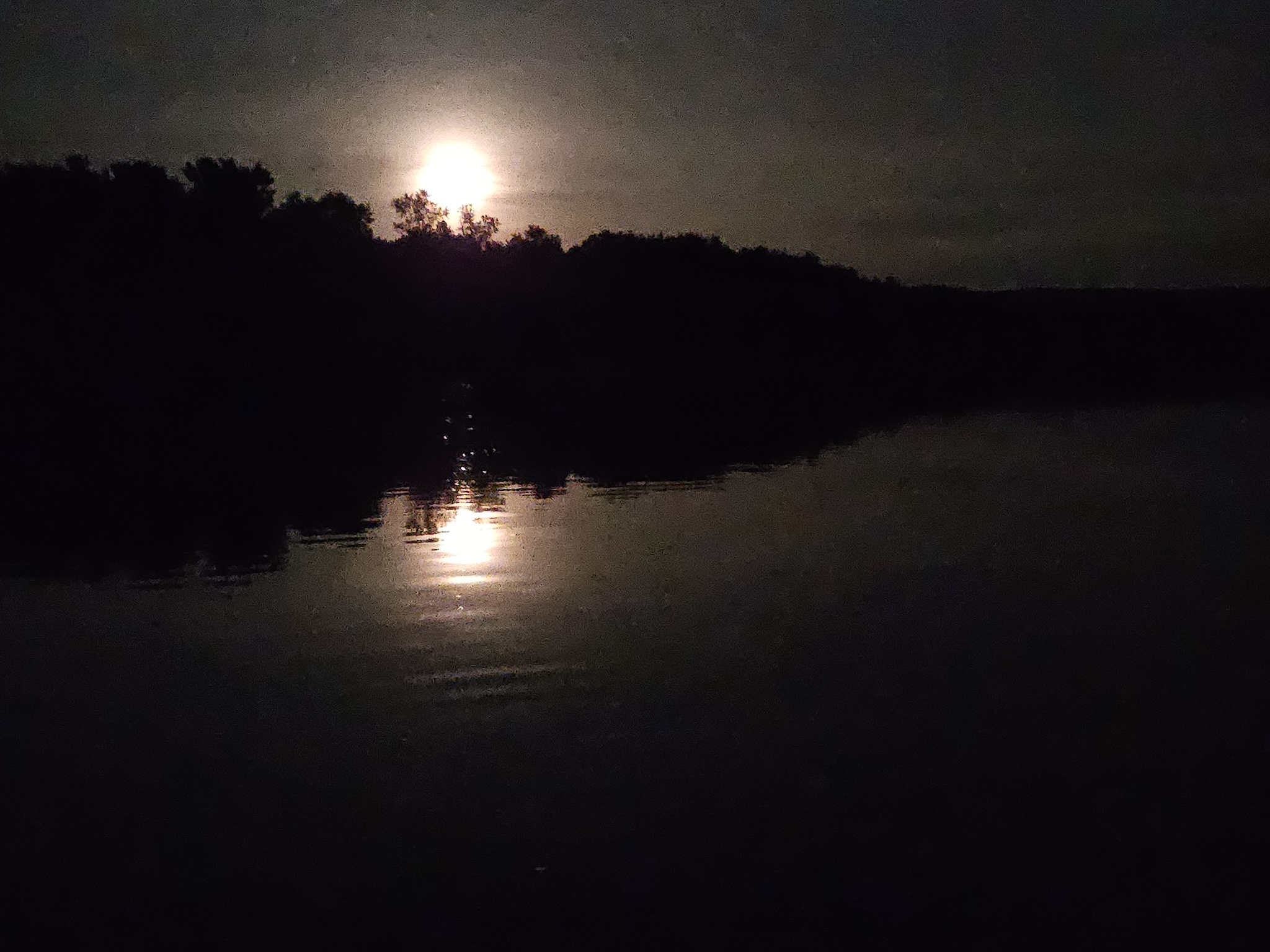
Moonlight on the river. (Greg Seitz/St. Croix 360)
The Girl Reporter started out nobly by putting her foot in the cherries.
“Huh—can’t you find any place to stow away those fool cherries?” grunted the friend.
The Girl Reporter started to—and almost tipped the canoe over. Then the girl friend had an inspiration. She rammed them tightly into the stern, where they wouldn’t be in anybody’s way.
The friend and the girl friend took their places.
“How’s the channel?” the friend inquired professionally of Mr. Muller.
“Well, you’ll find it kinda shallow, I guess. Keep to the left of the island down here, where you see an old sawmill, and you’ll be allright. Pretty shallow everywhere, I reckon, but you can get through, if you once find the channel.”
Nice and shallow! The Girl Reporter felt comfortable and reassured.
If the Girl Reporter had known—
But that’s just the point—she didn’t.
* * *
It was 8:30 and dark when they paddled out into the open river, from the narrow gorge formed by the dalles.
“Well, if we have any luck at all, we ought to be at Osceola by 10:20,” said the friend, laying his paddle across his knees for a moment and touching a match to his pipe.
For the first half hour or so, the Girl Reporter was thoroughly happy.
There is a fascination in being out on the water in a small boat at night that none can gainsay. The Girl Reporter had experienced this fascination in a limited degree during her nocturnal cruises on Lake of the Isles. This was like floating on Lake of the Isles—only more so.
Swiftly and silently they paddled down a path of silvery light made by the reflection of the starry sky in the water. On either side, dense shadows, creeping out into the river and fading back into the dim background of the receding bluffs. No electric lighted boulevard here—no glaring headlights.
Perfect silence—broken only by the gentle purling of the paddles and occasional splash when a fish jumped. No automobile horns, no street cars, no trains, no phonographs—not even the sound of a human voice. The Girl Reporter felt drowsy and peaceful.
Silently they stole past a ghostly white break in the shadows along the shore.
“That must be the abandoned sawmill Muller mentioned,” remarked the friend. “We’ll keep to the left.”
The Girl Reporter lay back against the friend’s traveling bag and began to count the stars.
She had counted 29, when suddenly there was a grinding sound from the bottom of the Muller III, and they stopped moving.
St. Croix 360 offers commenting to support productive discussion. We don’t allow name-calling, personal attacks, or misinformation. This discussion may be heavily moderated and we reserve the right to block nonconstructive comments. Please: Be kind, give others the benefit of the doubt, read the article closely, check your assumptions, and stay curious. Thank you!
“Opinion is really the lowest form of human knowledge. It requires no accountability, no understanding.” – Bill Bullard
Whoops! There was an error and we couldn't process your subscription. Please reload the page and try again.
By clicking subscribe, you agree to share your email address with St. Croix 360 and Mailchimp to receive emails from St. Croix 360. We will never share your information with anyone else.




Comment