Announcement: What do the Rusty Patched Bumble Bee, Morel mushroom, Monarch butterfly, and the Ursa Minor Constellation have in common? They are all state symbols of Minnesota! Come learn about the state symbols of Minnesota, why we have them, what ones you can see here in Afton State Park, and come up with your own Minnesota state symbol. Program starts at the Visitor Center, Saturday, May 9th 2 p.m. to 3 p.m.
Birds
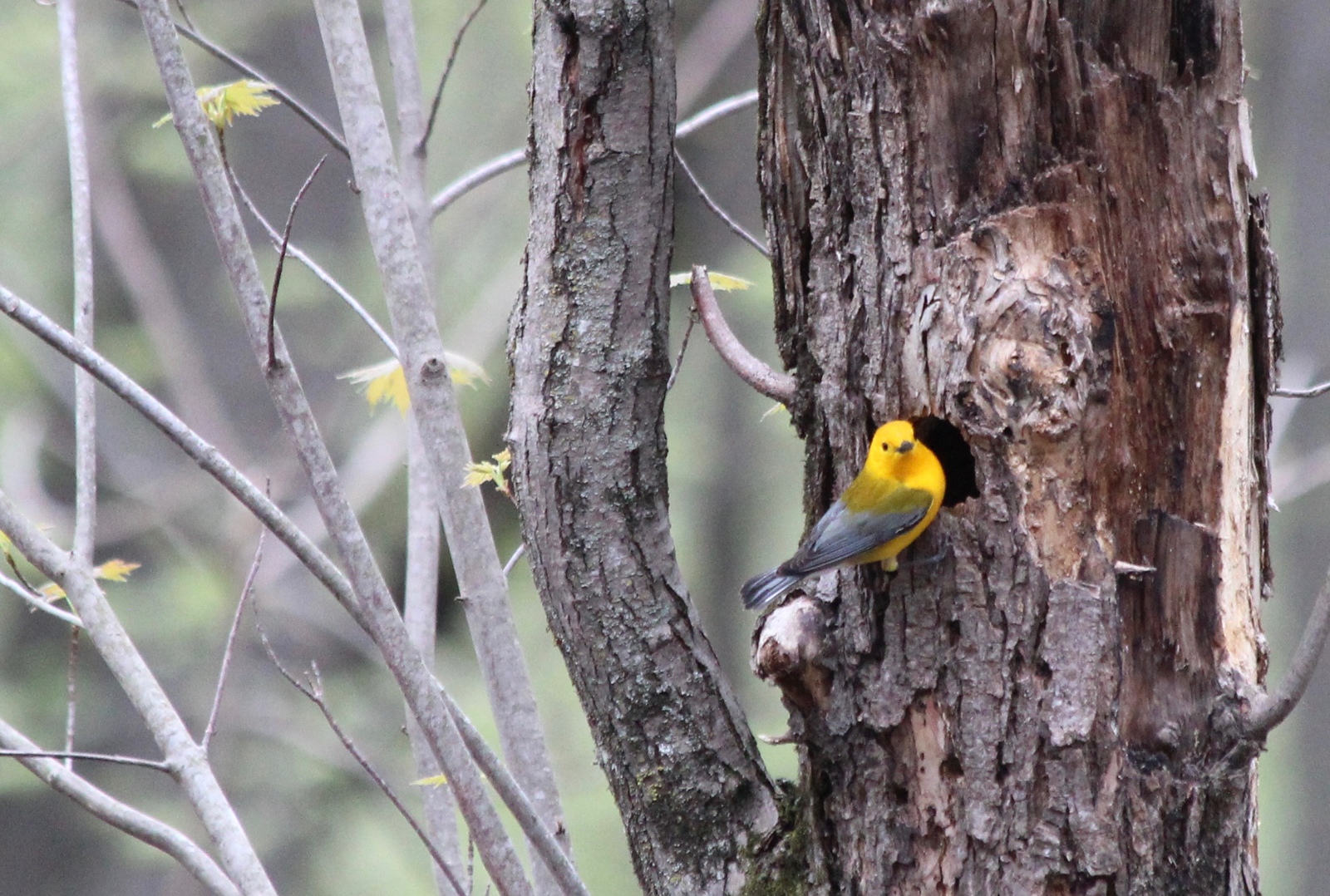
White-throated sparrows move through our area heading north. And the warbler migration continues! One of the most common to pass through our area is the Yellow- Rumped Warbler. You may also see Yellow Warblers, American Redstarts, and many others.
Some of the more brightly colored migrants are among the last to return to Minnesota, including the Rose-breasted Grosbeak, Baltimore Oriole, Indigo Bunting, and Scarlet Tanager.
Baby bird season continues, also. Robins are feeding nestlings, and ducklings paddle about in calm waters. Mallards lay a dozen or so eggs, more or less, but it is unusual for that many to survive to adulthood. Many predators rely on ducklings for food – Snapping Turtles and large fish such as Bass and Northern Pike may pull a duckling under water for a meal, Egrets and Herons sometimes catch ducklings, and Snakes, Coyotes, Skunks, and Raccoons may steal eggs or hunt ducklings.
When baby robins hatch their eyes are closed, their skin has no feathers, and they must rely on their parents entirely for food and warmth. They are not precocial like ducklings and goslings. The term used to describe robins and other birds that hatch before they have feathers is “altricial.” If you’re lucky you may see the shell of a robin’s egg beneath a nest. They’re a beautiful shade of blue.
Mammals
Many mammals are crepuscular. That means that they are most active at dawn and dusk, though they may sometimes be active at night (nocturnal) or in the daytime (diurnal). Some of the crepuscular mammals at Afton are Rabbits, Skunks, Red Foxes, Gray Foxes, and Raccoons. If you want to catch a glimpse of them, you’d better be crepuscular, too! Try hiking quietly in the early morning or evening, and being alert for sounds and movement. You just might see one of these crepuscular mammals! Wondering how you can distinguish between Gray and Red Foxes? Red Foxes have white tips on the ends of their tails, and black on their lower legs. Gray Foxes have black tips on the ends of their tails.
Insects
Buzzzzzzzzz . . . have you seen any bees yet? You might see Sweat Bees, Plasterer Bees, and Bumble Bees. Each of these is a family of bees, and the families include many different species. The Furrow Bees are members of the Sweat Bee family.
Plasterer Bees are solitary, as are most North American bees. After mating each female builds a ground nest with multiple cells, and lays an egg in each cell. She provisions each cell with nectar, pollen, and water, and then seals it off. A few days later the eggs hatch, and the larvae eat the provisions left by their mother. Then they make cocoons and overwinter, waiting until spring to undergo metamorphosis and emerge.
Female Sweat Bees mate in the fall before taking cover and overwintering as adults. They build nests in the spring. Sometimes overwintered females may share a nest and some of their offspring may function as workers, so they are sometimes described as “communal” bees.
Bumble Bees are the only bees native to North America that are social bees, like European Honeybees. Bumble Bees do not make honey, instead feeding directly on nectar and pollen. Queens overwinter as adults, then build a nest and lay eggs for the first brood of workers. Once the workers have metamorphosed into bees the Queen remains in the nest, laying eggs for more broods through the summer. Toward the end of the summer the Queen lays eggs that develop into males and females; these bees will mate and the females will overwinter to begin the cycle anew in the spring.
Black Swallowtail and Tiger Swallowtail butterflies start emerging in May and June. The caterpillars formed chrysalises in the fall, and with warming spring weather they metamorphose into butterflies and emerge. So you won’t see any caterpillars in the early spring, just butterflies! This first brood will mate and the females will lay eggs, which hatch four to nine days later. The caterpillars prefer foliage of plants in the carrot family, such as Queen Anne’s Lace, Wild Parsnip, American Cow Parsnip, and also the carrots and parsley plants in your garden! They eat and grow for 10 to 30 days, molting four times as they get bigger. Then the caterpillars form chrysalises and metamorphose into a second brood of Swallowtails, which will appear in late summer.
Plants
In the woods look for Wild Columbine, Wild Geraniums and Virginia Waterleaf, and also Elderberry flowers. Elderberries are a mid-sized shrub with compound leaves – that is, a leaf made up of several leaflets.
On the prairie look for Prairie Phlox. And continue to keep watch for Wild Strawberry leaves and flowers and remember where you see them. There will be Wild Strawberries to snack on while you’re hiking before long!!
You may also see Rue Anemone and False Rue Anemone in the woods. What’s the difference between them? Rue Anemone has five to ten petal-like sepals, while False Rue Anemone ALWAYS has only five.
Weather observations
Here are some weather observations from the Afton State Park area from past years.
Friday, May 8
2024: sunny and pleasant, mid-70s; 2019: rain through the day, temperature in the 40s
Saturday, May 9
2024: partly sunny and breezy, 60s; 2022: unsettled afternoon, thunderstorm with one-inch hail; 2015: 40s in the morning, rising into the low 70s by afternoon
Sunday, May 10
2024: Very windy, 60s; 2022: sunny and 80°; 2020: 40s and cloudy in the morning ; 2017: high of 69°
Monday, May 11
2024: sunny and 70s; 2022: thunderstorm, high winds, and record rainfall of 1.94 inches; 2021: high in the low 60s and sunny
Tuesday, May 12
2024: sunny and breezy, high of 88° with smoke from wildfires in British Columbia; 2022: fog early, then a record high of 92°; 2020: sunny and pleasant, near 60°
Wednesday, May 13
2024: smoke advisory through day; 2016: red sky in the morning and a half inch of rain before noon. The old saying goes: “Red sky in the morning, sailor take warning. Red sky at night, sailor’s delight”; 2007: record high of 92°
Thursday, May 14
2023: rain until late morning, then sunny; 2020: A little rain overnight, temperatures in the 60s; 2019: flood on the St. Croix nearly completely submerges the stairs at the beach; 2013: record high of 98°
Image credits:
All photos and images used by permission.
Copyright Nina Manzi, except:
Chuck Hendrikson: White-throated Sparrow
Keith Henjum: Yellow-rumped Warbler
Dean Lokken: American Robin, Rabbit, Scarlet Tanager
Gary Sater: American Redstart, Baltimore Oriole, Indigo Bunting, Rose-breasted Grosbeak, Whitetail Deer, Yellow Warbler
Zosh Tanner for Friends of the Mississippi River: Ligated Furrow Bee, Plasterer Bee, Silky Striped Sweat Bee
St. Croix 360 offers commenting to support productive discussion. We don’t allow name-calling, personal attacks, or misinformation. This discussion may be heavily moderated and we reserve the right to block nonconstructive comments. Please: Be kind, give others the benefit of the doubt, read the article closely, check your assumptions, and stay curious. Thank you!
“Opinion is really the lowest form of human knowledge. It requires no accountability, no understanding.” – Bill Bullard


Comment