Note, programs may have their locations changed or be canceled depending on the weather and air quality, please check the DNR State Parks and Trails Events Calendar for details about event changes.
Track Tales, July 18 from 10 a.m.-12 p.m. near the Visitor Center: Ever wonder what animal made those tracks in the mud? Stop by the Naturalist Table near the swim beach between 10 a.m. and 12 p.m. to learn how to identify animals and what they were doing based on their tracks.
Pollinator Walk, July 18 from 2-3 p.m. starts in the Visitor Center: Join a naturalist in learning all about pollinators! There will be a short presentation in the Visitor Center, followed by a Pollinator Discovery Walk around the Prairie Interpretive Trail, where we will search for and learn about pollinators and the wildflowers they love. This is a 0.5-mile non-strenuous walk, with no sun cover or pavement. Please come prepared with bug spray, sunscreen, and a hat for sun protection.
S’morey Time, July 24 from 7-8 p.m. near the Visitor Center: Gather around the campfire for S’morey Time, a storytelling program made for young adventurers! A naturalist will read a nature-themed book, followed by toasting marshmallows for gooey s’mores. We will be using the firepit outside the Visitor Center, so bring bug spray for the evening mosquitos! This program is perfect for preschool-early elementary school kids. Parents are required to stay during the program duration. Dietary options are not available, but visitors are welcome to bring their own options if they want.
SPECIAL PROGRAM! Universe in the Park, July 24 from 8:30-10 p.m. near the Visitor Center: Join scientists from the University of Minnesota for an engaging night of astronomy. The night will begin with a 10-15 minute talk on an engaging astrophysical topic. Past topics have included the life and deaths of stars, the local group of galaxies, and even the Big Bang. After the presentation, look through telescopes for a close view of the celestial objects in the night sky. We’ll have the telescopes, you just need to bring your curiosity and questions!
Astronomy
The planet Venus is to the right of the Crescent Moon on Friday the 17th. On Monday the 20th, the Moon will be below the blue star Spica, in the constellation Virgo the Virgin. Spica is the eleventh-brightest star visible to us in the Northern Hemisphere.
Birds
Canada Geese lost their flight feathers several weeks ago and have been growing new ones for the fall migration. Until then, they’re grounded!
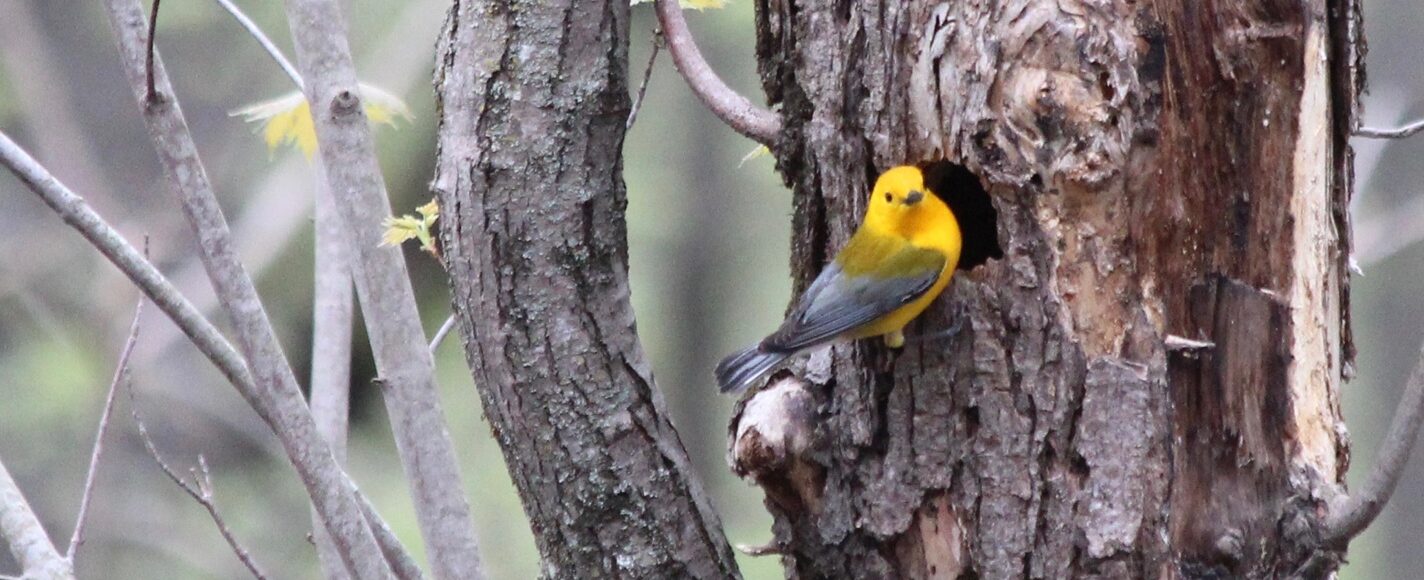
Many species of birds have fledged their young and are done nesting for the year. This is especially true of species that go south for the winter and are only here for a short time. One result is that it’s a lot more quiet in the early morning hours; once a species is done nesting the males have no need to sing to defend their territory or attract a mate. But the birds that have multiple broods of young, called “recurrent nesters” are still singing at dawn. Some of the recurrent nesters at Afton are American Robins, House Wrens, Cardinals, Eastern Bluebirds, Mourning Doves, and Red-bellied Woodpeckers.
Mammals
Look for bats flying after sunset. Bats in our area have been affected by a disease called “white nose fungus”. Infested colonies wake up from hibernation in the winter, which often causes their death. Bats need our help: a 2021 study estimated that white nose fungus has resulted in the death of 90 percent of the Little Brown Bats, Northern Long-eared Bats, and Tri-colored Bats in North America. Scientists are testing a vaccine that appears to protect bats from the fungus; the next step will be to find a way to administer it that doesn’t require bats to be captured and handled. And there are tests of using UV lights in bat caves to kill the fungus, and feeding bats probiotics to strengthen their immune systems. You can help protect bats by staying out of caves where bats hibernate and making your yard bat-friendly by retaining large trees or putting up bat houses. And enjoy the aerial acrobatics of any bats you see at Afton– they eat lots of mosquitoes!
Also watch for chipmunks and red squirrels when you’re hiking or biking at Afton. If you hear something chattering away when you hike past, it may very well be a red squirrel or a chipmunk.
Amphibians and reptiles
Look for snakes and turtles basking in the sunshine. It’s thought that garter snakes got their name from the garters that both men and women used to tie around the upper end of their socks to keep them from falling down, back before there was elastic. Those garters often had stripes, like the snake.
Insects
Two species of “lady” butterflies are on the wing at Afton in the summertime: the Painted Lady and the American Lady. Both are brushfoot butterflies. Brushfoot butterflies have six legs but the two front legs are very short and brushy so you will see the butterflies perched on four legs. The Crescents and Red Admirals are also brushfoot butterflies.
The Painted Lady is common at Afton. It has four small eyespots on its hindwing. The American Lady has two big eyespots. Current research suggests that Painted Ladies and American Ladies from overwintering populations farther south in the U.S. fly north to Minnesota in the early spring and summer, producing several broods in our area before winter comes again. It isn’t clear if the butterflies here in the fall fly south to overwinter, or die off.
National Moth Week starts on Saturday! Curious about moths? Visit NationalMothWeek.org to learn more, and set up your own light trap to see what moths are near your home. Hang up a white cloth outdoors away from artificial light, then set up a light on one side of it. An old sheet works well for this. Before long moths will come and land on the cloth, giving you a chance to have a look at night-flying moths. Or, if you have a black light, set it up outdoors after dark and see what moths come to visit. In the meantime, check out this beautiful day-flying moth. It’s the Chickweed Geometer. Chickweed is one of its host plants, and “geometer” is Greek for “earth measure”. The larvae of all the moths in the Geometer family are inchworms, which look like they’re always measuring whatever they’re crawling across.
The Large Maple Spanworm Moth and the Sulphur Wave Moth are also geometers, so their larvae are also inchworms.
In the close-up of the Chickweed Geometer’s antenna, notice the bristles on both sides of the antenna. This kind of antenna is called “bipectinate”. “Pectinate” means “comb”, and “bi” means that they’re on both sides of the antenna. The Large Maple Spanworm Moth and the Sulphur Wave Moth also have bipectinate antennae. Only the males have these bipectinate antennae; the feathery comb structures help them sense and find female moths. Female moths emit special pheromones, and the male moths sense the pheromones with their antennae, allowing them to find the females.
Plants
Look for Virginia Mountain Mint, Oxeyes, and Blue and Hoary Vervain blooming on the prairie.
Not everything that looks like it’s a grass really is a grass! Some may be sedges, and others may be rushes. Here’s one version of a little poem that will help you tell if the plant you’re looking at is a sedge, a rush, or a grass.
Sedges have edges Rushes are round Grasses have knees that bend to the ground
If you feel a sedge, you’ll find that the stems are triangular and have sharp edges. The stems of rushes are smooth tubes with no nodes anywhere. The stems of grasses are also roundish, but they have nodes between leaves up and down the length of the stem. You might find Bottlebrush Sedge, Path Rush, and Bottlebrush Grass at Afton.
Weather observations
Here are some weather observations from past years.
Friday, July 17
2024: breezy and in the 70s; 2023: cloudy and cool, in the 70s; 2015: very humid, with high in the 80s
Saturday, July 18
2024: sunny and pleasant, 80s; 2023: sunny and breezy with a high in the 70s; 2015: thunderstorm after midnight brings ¾” rain
Sunday, July 19
2023: rain and thunder early in the morning; 2022: heat advisory, high of 95°; 2011: steamy and 80s in the morning, with a powerful mid-morning thunderstorm
Monday, July 20
2013: 60s in the morning, rising into the 70s
Tuesday, July 21
2022: temperature in the 80s with a dry wind; 2015: sunny and pleasant, high near 80°
Wednesday, July 22
2020: high of 69°
Thursday, July 23
2020: sunny and pleasant, in the low 80s
Photo credits
All photos and images used by permission.
Copyright Nina Manzi, except:
Dean Lokken: Chipmunk, Mourning Dove
Deborah Rose, MN Conservation Volunteer: Bat
Gary Sater: Cardinal, Eastern Bluebird, Red Admiral, Red-bellied Woodpecker
St. Croix 360 offers commenting to support productive discussion. We don’t allow name-calling, personal attacks, or misinformation. This discussion may be heavily moderated and we reserve the right to block nonconstructive comments. Please: Be kind, give others the benefit of the doubt, read the article closely, check your assumptions, and stay curious. Thank you!
“Opinion is really the lowest form of human knowledge. It requires no accountability, no understanding.” – Bill Bullard
Whoops! There was an error and we couldn't process your subscription. Please reload the page and try again.
By clicking subscribe, you agree to share your email address with St. Croix 360 and Mailchimp to receive emails from St. Croix 360. We will never share your information with anyone else.


Comment