

Astronomy
Constellations that are near the North Star are called “circumpolar.” As the night goes on, they rotate slowly around Polaris, the North Star. Here at close to 45 degrees north latitude, we can see the Big Dipper all night long, and use the two stars at the end of its bowl as pointers to find Polaris. But if we were farther south, the Dipper would sometimes dip below the horizon. And even at our latitude it might sometimes be obscured by trees or hills. If that happens, you can use the stars in the constellation Cassiopeia as pointers to find Polaris! Cassiopeia looks like a letter “W” in the sky. The stars in Cassiopeia don’t point as directly to Polaris as do the stars in the Dipper, but they are close enough to work. And note that the Big Dipper isn’t a constellation, but instead an “asterism”, which is the word for a group of stars within a constellation. The Big Dipper is part of the Great Bear, or Ursa Major. Some people consider the Little Dipper to be just another name for the constellation Little Bear, or Ursa Minor, since it consists of the seven principal stars in Ursa Minor, while others think of it as an asterism.


Birds
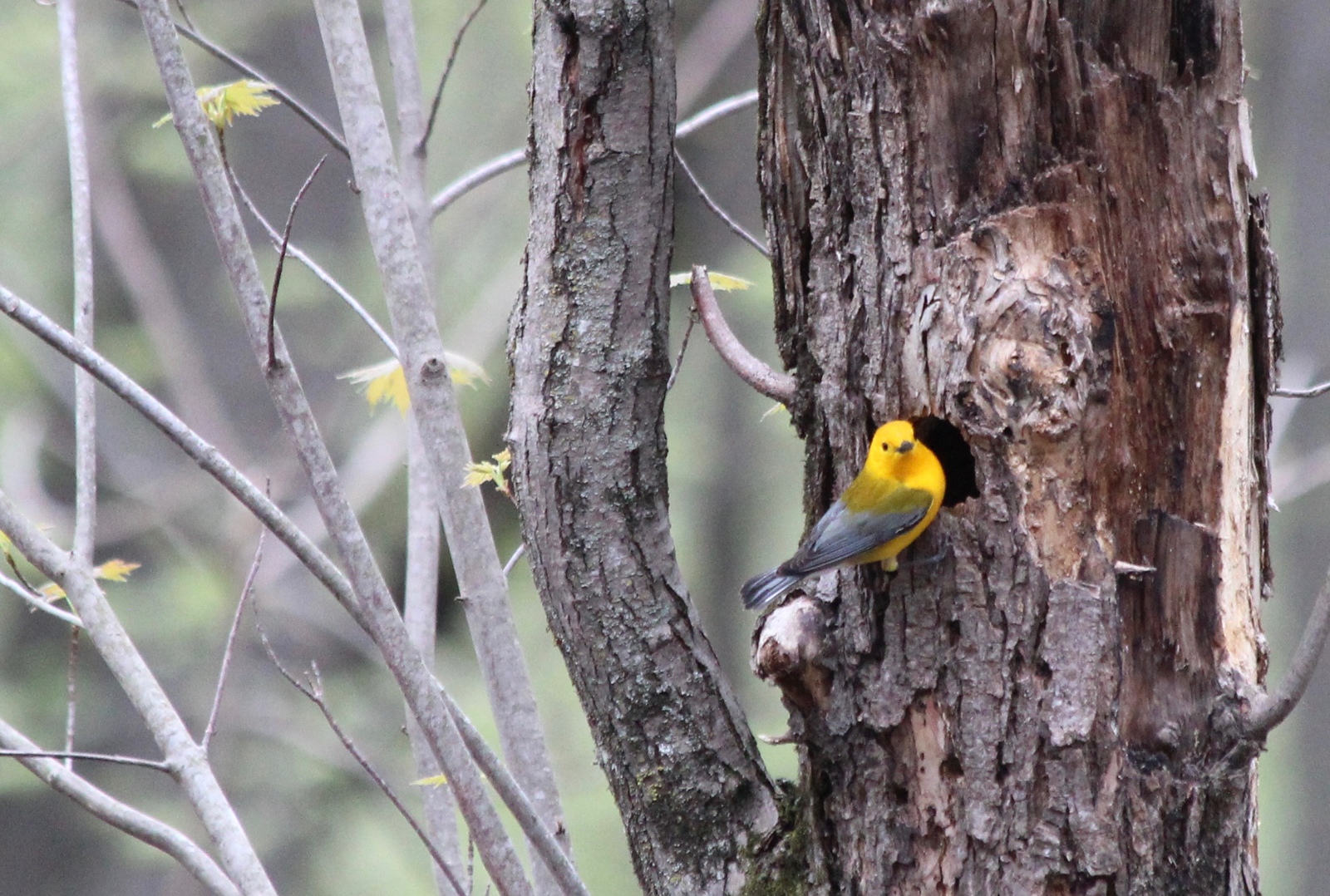
Juncos continue moving through our area on their way to points farther north. Many of the Juncos that we see in April are ones that spent the winter farther south, in Iowa or Missouri. The ones that wintered at Afton are probably already gone. Around mid-April Northern Flickers also pass through Afton, and like the Juncos are on their way north. Flickers are a kind of woodpecker, but unlike most woodpeckers they are primarily ground feeders. They really like to eat ants. They use their beaks to peck holes in the earth, and their long tongues to slurp up ants. Chickadees and Pileated Woodpeckers are excavating nest holes. Woodpeckers and Chickadees make new nest holes each year; the old abandoned ones provide nesting opportunities for other species of birds and also mammals. Woodpeckers may choose a place on a dead tree where the bark has been softened by fungi, and may even transport that particular kind of fungus on their beaks from one tree to another.


Mallard Ducks, Wood Ducks, and Mergansers begin nesting in April. When these birds are nesting you are much more likely to see the more colorful males, which are called “drakes,” than you are to see the females, called “hens.” Mallards typically nest on the ground, while Wood Ducks and Mergansers are “cavity nesters,” building their nests in hollow trees, old Pileated Woodpecker holes, or nest boxes, although Mergansers sometimes nest on the ground. After laying eggs the hens spend most of the day sitting on the nest and incubating the eggs, and their drab coloring provides excellent camouflage. They leave the nest for only a short time each day to wet and preen their feathers.


White-throated Sparrows are passing through our area heading north. Some people say their whistling call sounds like “O Sweet Canada Canada”, others think it sounds like “Old Sam Peabody Peabody.” And the first Yellow-rumped Warblers may have arrived; they are the earliest of the warblers to return to Minnesota in the spring.


Visitor reports of birds from 2025: Visitors to Afton observed these species: Black-capped Chickadee, Golden-crowned Kinglet, Cedar Waxwing, Eastern Meadowlark, Yellow Warbler, two male Canada Geese battling over a female, and Common Loon diving into the St. Croix River.


Amphibians and Reptiles
On warm overcast or drizzly days you might see Tiger Salamanders leaving their hibernaculae and fanning out across the countryside. There’s a hibernaculum where the salamanders spent the winter somewhere south of 70th St., which leads into Afton, so you could see salamanders in the park! And on warm sunny days look for turtles and snakes basking in the spring sunshine. Turtles may look like they’re just sitting around in the sun, but they’re busy digesting! The warmth of the sun helps them to digest the aquatic plants they ate earlier. If you’re biking at Afton watch out for basking snakes on the trail so you don’t run one over.


Mammals
Gray and Red Squirrels are active all year at Afton, and among the animals you are most likely to see when you hike. Skunks and Raccoons are not true hibernators, but go into torpor to save energy on cold winter days. Now that spring has arrived both Skunks and Raccoons become more active. If you’re camping at Afton be sure to secure your food for the overnight, or you might wake up to find that a Raccoon ate your breakfast!


This is the time of year when the first litter of Rabbit kits is born. Baby Rabbits are helpless and blind when they are born and rely on remaining still and quiet in their nest, which is called a “form,” to evade predators while the mother Rabbit is out foraging for food. Rabbit kits leave the nest when they are two to three weeks old.


Insects
Monarchs aren’t the only insects that conduct a multi-generational migration. For many years entomologists knew that Green Darner Dragonflies flew away from the upper Midwest in the fall, and returned in the spring, but no one was quite sure what was going on in between until 2019, and the research relied in part on sightings from citizen scientists like you and me! Another key to solving the puzzle is that there is a rare form of heavy Hydrogen that is more common in the south than in the north, and this hydrogen is present in the wings of dragonflies, which allowed researchers to distinguish southern dragonflies in museum collections from northern ones.


In February a brood of Green Darners completed their metamorphosis into adults far south of here, in the southern United States, Mexico and the Caribbean. These dragonflies began flying north after metamorphosing into adults, and if this is a typical year they began to reach Minnesota and Afton State Park in late March or early April. They will mate and lay eggs in ponds and quiet pools here. Some dragonflies from this second generation will complete development into adults and fly south, some leaving as early as July, while others will overwinter here as nymphs and fly south the following year. But that’s not all! When the south-bound generation of adults arrive at their overwintering site, they will lay eggs, and the third generation of dragonflies will spend their entire lives in the south. It will be their offspring that fly north in the spring. So the Green Darners we will see in early spring are the grandchildren of the ones that flew south last fall, and the great-grandchildren of the ones that we welcomed back to the Northland last spring.
Plants
Each week from now through early fall, we will see new species of flowers coming into bloom, providing bees and other pollinators with plenty of blossoms to visit. Early bloomers include Hepatica, Bloodroot, Dutchman’s Breeches, Wild Violet, Large-flowered Bellwort, Wild Ginger, and Yellow Trout Lily. Dutchman’s Breeches look like old-fashioned short pants. Wild Violets look like the common garden flowers, but the flowers are much smaller and range in color from purple to red.


Bellworts have yellow flowers that hang downward in a cluster, and Wild Ginger has small reddish flowers near the ground that resemble jester’s caps. Trout Lilies take their name from the mottled pattern on their leaves, which look something like the dappling on a trout.


Consider taking a drive south to Nerstrand Big Woods State Park to look for the Dwarf Trout Lily, which grows in only a few places in Minnesota.
Weather Observations
Here are some weather observations from the Afton State Park area from past years.
| Friday, April 3 | 2025: 30s in the morning and calm; 2024: gusty winds up to 40 miles per hour, high in the 40s; 2021: lovely day in 70s; 2020: rain and snow off and on throughout day; 2018: record snowfall of 7.5 inches |
| Saturday, April 4 | 2024: clouds and sun alternate through day, 40s; 2022: ½ inch of wet snow overnight; 2021: record high of 85°; 2020: cold overnight, in the 20s in the morning |
| Sunday, April 5 | 2025: sunny and breezy, in the 40s: 2024: sunny and pleasant, 50s; 2022: rain off and on through day; 2021: record high of 85°; 2016 red sky in the morning (sailors take warning!) and blustery winds and rain in the afternoon. |
| Monday, April 6 | 2024: sunny and breezy, high 50s; 2022: rain changes to snow overnight; 2020: cloudy and mild, in the 50s; 2006: record rainfall of 2.58 inches |
| Tuesday, April 7 | 2025: sunny and cool, in the low 40s; 2024: rain through day, 40s: 2023: Sunny and in the 50s; 2022: rain mixed with snow through day; 2021: thunderstorm in the morning |
| Wednesday, April 8 | 2023: Sunny and in the 60s; 2022: dusting of snow overnight; 2021: rain off and on through day, temperature in 60s |
| Thursday, April 9 | 2016: Frost on roofs in the morning, high in the upper 30s |
Photo/image credits
All photos and images used by permission.
Copyright Nina Manzi, except:
- Keith Henjum: Hooded Mergansers, Raccoon, second Yellow-Rumped Warbler
- Susan Kewley: Rabbit kits
- Dean Lokken: Dark-eyed Junco
- Gary Sater: Cedar Waxwing, Common Loon, Gray Squirrel, Male Mallard Duck, Northern
- Flicker, Wood Ducks, Yellow Warbler, first Yellow-rumped Warbler


Comment