

The National Park Service’s Great Lakes Inventory & Monitoring Network is led by a special team based out of Ashland, Wis. and working in National Park around Lake Superior, including the St. Croix National Scenic Riverway. The network is one of 32 found across the United States. “Great Lakes Network scientists use the parks for science and our science is used to help the parks,” the agency says.
The network’s newsletter comes out twice a year with reports on the group’s activities and findings, compiled by editor Ted Gostomski. Here are several items from the most recent newsletter about work in the St. Croix Riverway (SACN):
Working with colleagues from the University of Minnesota and the St. Croix NSR, network staff provided both canoe paddlers and divers to help conduct a baseline inventory of native mussel beds on all 100 miles of the Namekagon River this spring. A mild winter left water levels lower than usual, so both canoeing and snorkeling were sometimes difficult, but the crew was successful in locating more than 9,000 beds, most of which (80%) were low density (fewer than four mussels per square meter, or 11 square feet); 20% of the beds were classified as high density (more than four mussels per square meter).

Working with a physical scientist from the USGS New England Water Science Center, retired NPS fisheries biologist, Jay Glase, and Dr. Patrick Shirey from the University of Pittsburgh, network staff returned to the upper Namekagon River in September to assist with a study that will inform brook trout habitat suitability and restoration potential on the uppermost 20 miles of the Namekagon River (SACN). With funding from the NPS-USGS Natural Resource Preservation Program (NRPP), this project is using thermal imagery to identify existing and potential habitat for brook trout and other cold-water fish species by locating where coldwater seeps enter the river. During our visit in September, forward-looking infrared radar (FLIR) was used to locate and map the locations of coldwater seeps. Using this information, a return is planned in 2026 to refine the data using an uncrewed aircraft system (UAS) to fly over selected one-mile reaches of the river and collect both thermal and natural color imagery.

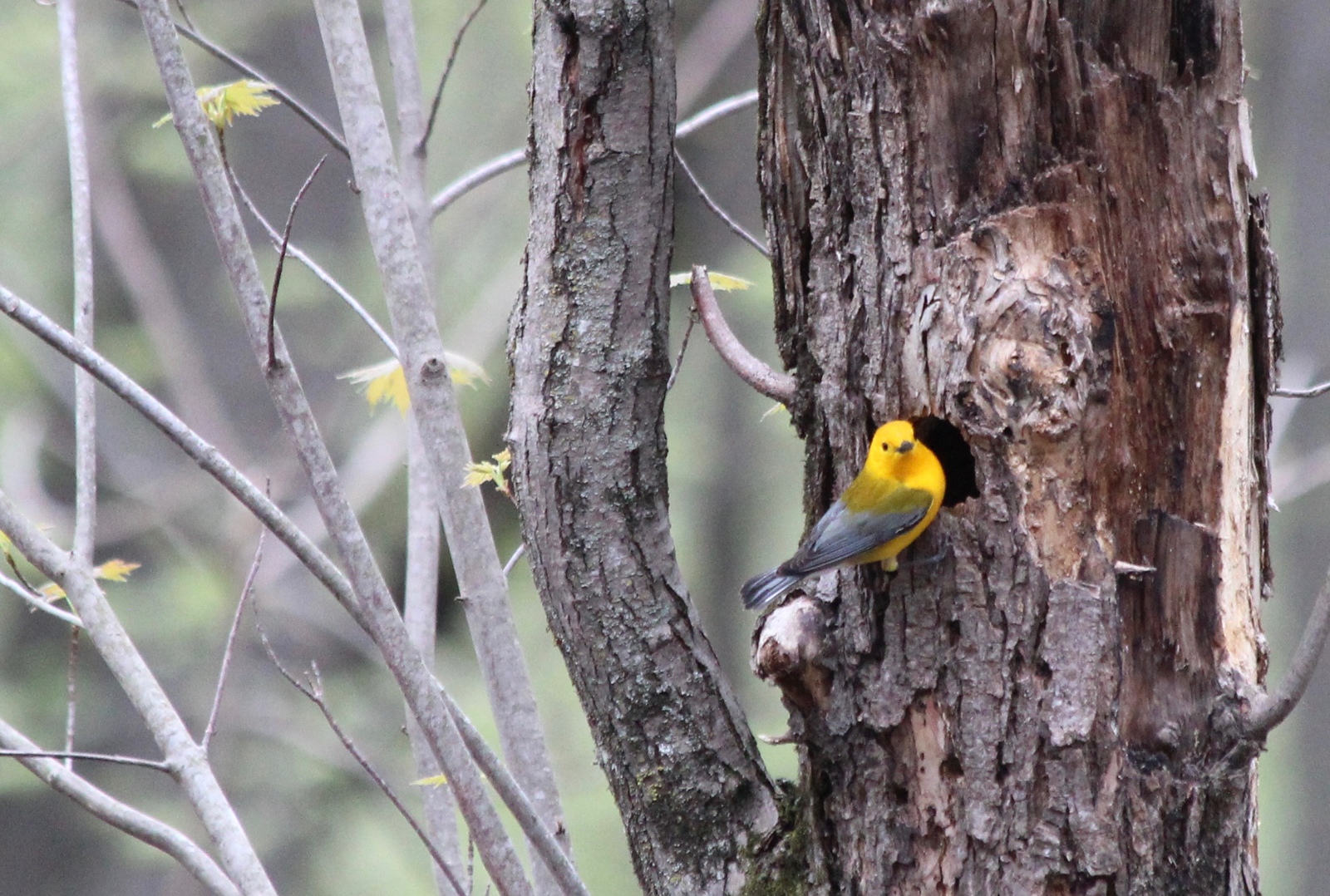
Our observer at SACN reports that Golden-winged Warbler hotspots are starting to show themselves with clarity, and parts of the St. Croix and Namekagon Rivers are proving themselves to be critical strongholds of habitat for this species. So, too, with Canada Warbler and Prothonotary Warbler. Perhaps most exciting, though, was his non-bird observation.
It took a while, but I think it was about 430 river miles along these six years before I finally had a riverside wolf encounter! I was paddling down through a rapid on the upper Saint Croix with the early rising sun at my back and fog rising delicately off the water. As I was navigating the rapids, I happened to look at the far shore line. There, as if presented in a shaft of light, a large, mature wolf stood in the water, fog rising around his legs. I was fast approaching, but I was also avoiding rocks and moving silently through the rapid. The big wolf’s ears were cupped toward me, and he was standing and looking, head on. As I approached to within 75 meters, he turned, revealing a beautiful tricolored coat, tall white legs, cream-colored and cinnamon sides, and a black guard-haired back. He moved his face to the water and began lapping up a drink. I could see his pink tongue lapping, but any sound was drowned by the rush of the rapids. Now, as the rapids pulled me to within 20 meters, the wolf got nervous and moved off into the alders, disappearing from view. At one point, as I passed the alders, following the bend in the river, I could see his shoulder, less than 10 meters away! I had once reached for my camera, but the rapids demanded my hands and constant attention on the paddle.
I wanted to see more. As joyful as I was that I had just enjoyed a rare and scenic moment, a gift from the river, I also felt excitement. … I had to resign the feeling of “capture” and look for the joy in that beauty. But ahead, at the end of the rapids, there was a broad, flat rock. I grew mischievous. I deliberately high centered on the rock and arrested my travel. The current slowly swung my canoe’s bow back upstream. I was now facing the last place I had seen the wolf. I opened my Pelican case, and I got my camera ready. In the midst of work flow, I set my stopwatch for 10 minutes. It would be a short wait, but maybe worth the delay. With less than two promised minutes left, I had a strange feeling and turned to look over my shoulder, downstream. There, in the shadows and fog, a much younger wolf was watching me. I turned and took a quick burst of images before the young wolf slipped back into the alders. With a big grin on my face, I pried free of the flat rock and headed to the next bird survey.
We measured a core and extended suite of water quality parameters at eight sites along the St. Croix and Namekagon Rivers each month from April through October, with some exceptions. In previous years, eleven sites were visited each round. In 2025, we suspended sampling at the three lower-most sites on the St. Croix River located at Bayport, Hudson, and Prescott. We did this to reduce the cost of laboratory analysis and because because the sites are already monitored by another agency.
In April, sampling was delayed by approximately two weeks due to uncertainty over travel rules for fieldwork. When fieldwork commenced in mid-April, only seven sites were sampled. As a result, we could not sample the Highway 70 site. In May, all river water quality work was canceled, as continuity planning work took precedence. Sampling proceeded as expected from June through October. The November round was missed due to the extended government shutdown. Invertebrate samplers were deployed at eight sites in July and collected in September.


Comment